Acura’s Nexera Vision Is a Sports Car That Points Straight at the RDX
The two-seat concept will not become Acura’s next production sports car, but its lighting, proportions, and materials are headed toward roadgoing models.
A concept built to move the brand forward
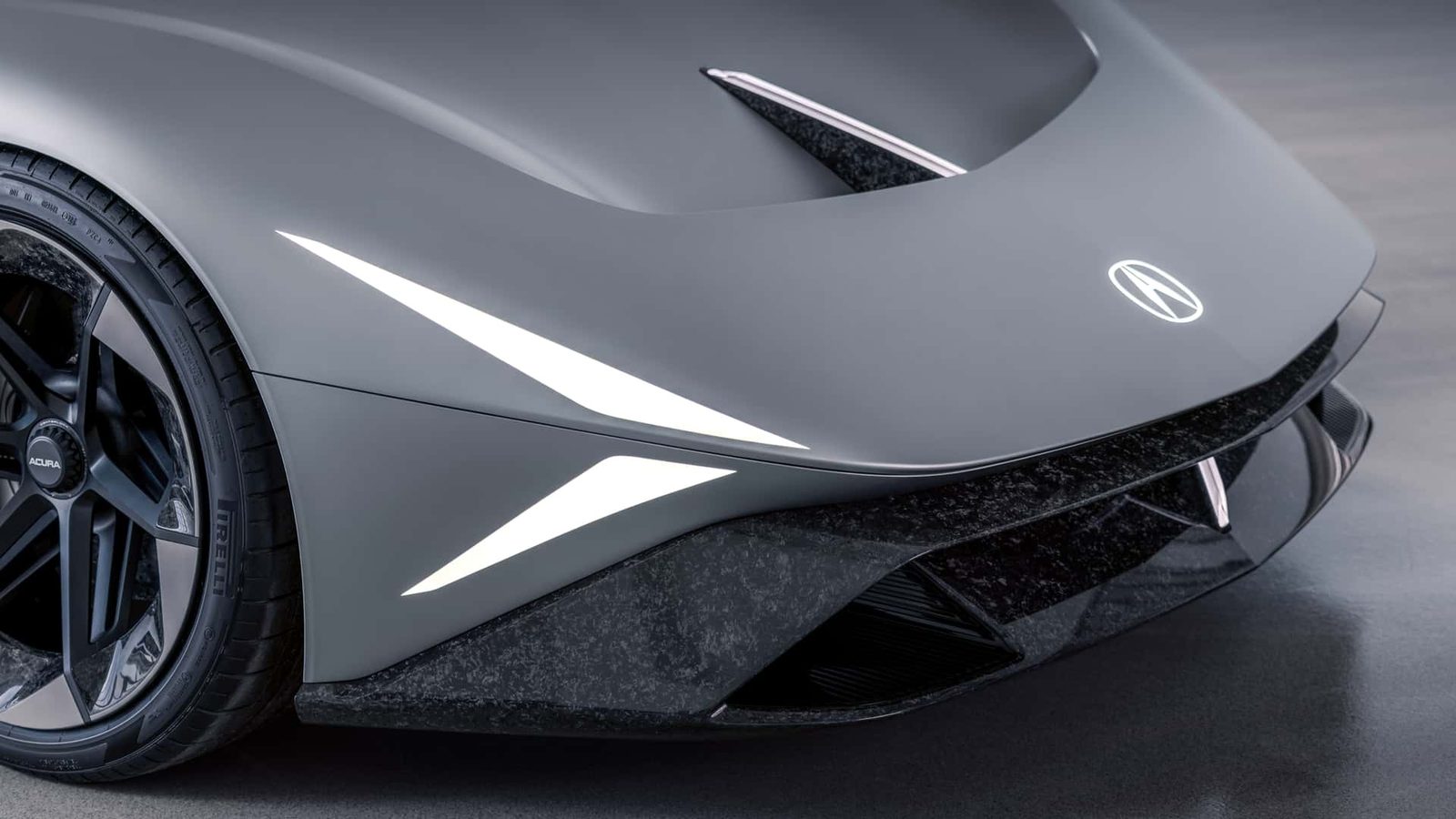
The Acura Nexera Concept is not a preview of a production sports car or a revived NSX. It establishes Acura’s next-generation design language through smooth lines, muscular wheel arches, and hidden lighting that incorporates the brand’s signature A-Mark.
The Nexera makes its global debut at The Quail during Monterey Car Week. The concept itself will not enter production; instead, Acura will carry elements of its design, including the signature lighting, to future production models.
The next-generation RDX Hybrid, arriving in the coming years, will be the first production model to receive Nexera-inspired design elements.
The lighting does the talking
Yasutake Tsuchida, Acura’s creative director and vice president of design, led the project at the company’s Acura Design California studio in Los Angeles. His team gave the Nexera a surface treatment that hides much of its visual technology until the car is switched on.
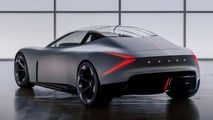
Twin triangular headlights disappear beneath the Matte Titanium finish when inactive. The rear lighting follows the same concealed, geometric logic, allowing the bodywork to read as one smooth form rather than a collection of lamps and grilles. Muscular wheel arches keep the profile from becoming delicate, while soft haunches and a long glasshouse give the coupe its planted stance.
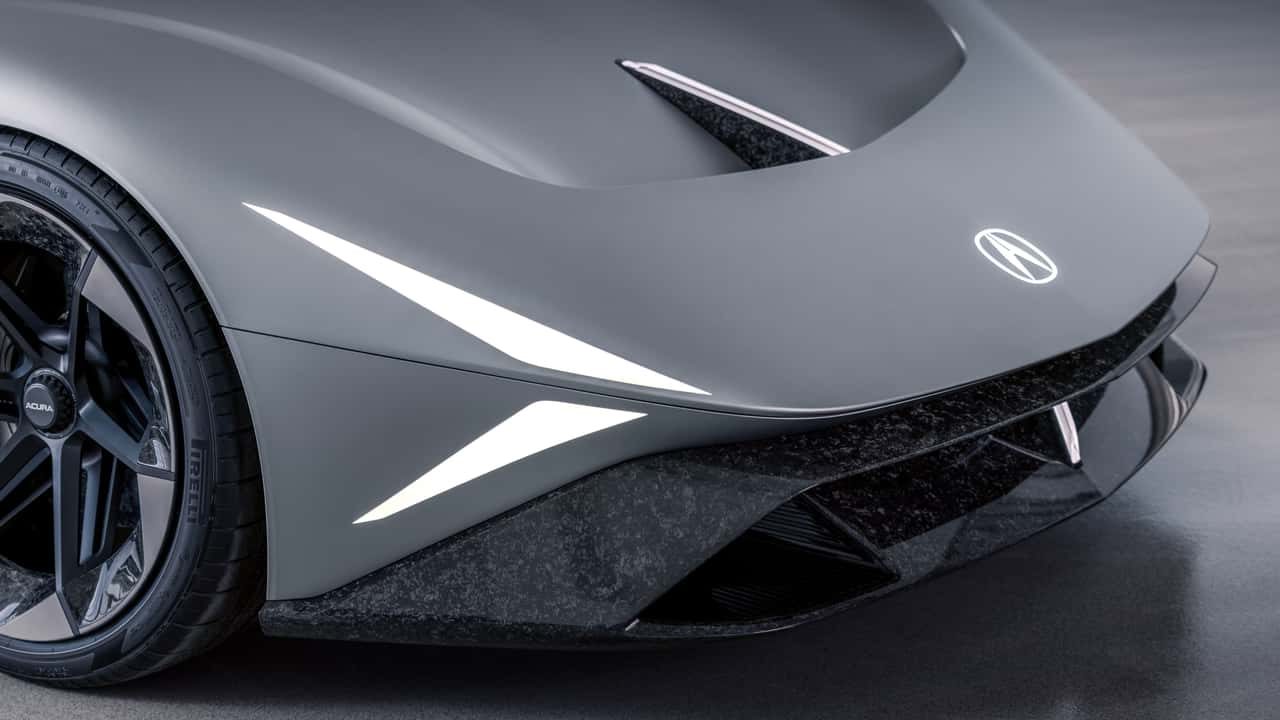
The nose adds another unusual detail. A slim, fish-like opening is not a cooling intake; it filters air upward and across the hood, with LED strips dividing the channel. That arrangement makes airflow part of the design instead of hiding it behind a conventional grille. The result is a front end whose strongest feature may only appear once the electrical systems are active.
A cabin designed around the driver
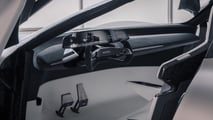
Entry comes through dual-hinge butterfly doors, but the more radical decision is inside. The bucket seats are molded into the floor and fixed in place, putting the occupants low in the structure rather than allowing the seat itself to travel. The yoke-style steering wheel and pedals adjust instead.
That layout leaves the dashboard unusually clean. A curved digital display sweeps across the driver’s field of view, with controls concentrated around the wheel and center console. Behind the seats, a parcel shelf incorporates a storage compartment, giving the strictly two-seat cabin a defined space for belongings without pretending to offer rear-seat utility.
Material choices push the concept beyond visual theater. The interior uses recycled-polyester Alcantara, recycled aluminum, and CircuLeather, a leather made from hides left over from food production. CircuLeather is also described as repurposable as fertilizer after its useful life. Those details give the cabin a sustainability story, while the fixed seating and yoke keep its priorities unmistakably focused on a low driving position.
Serious hardware, unanswered questions
The Nexera carries Acura’s first center-lock wheels, sized at 22 inches. Carbon-ceramic Brembo brakes sit behind them, supplying the most concrete performance hardware attached to the concept. An active rear spoiler rises from the body at speed, and a prominent diffuser completes the rear treatment.
Forged carbon appears across the lower fascias, side sills, rear diffuser, and interior trim. The material is made through compression molding, but it is decorative rather than structural; the concept does not use carbon fiber as its primary body structure.
Those components establish the car’s intent without establishing its capability. Acura has provided no meaningful powerplant or drivetrain specification for the Nexera. There is no output figure, range estimate, acceleration claim, or transmission detail to use for a buying comparison. The center-locks, brakes, and aero hardware therefore function as design signals and engineering punctuation, not as a performance specification for a production vehicle.
The RDX is where the ideas become real
Acura has tied the Nexera’s first production application to the next-generation RDX Hybrid. The compact crossover will receive the concept’s design elements, including the new lighting signature, making it the practical test of whether this dramatic language works above a showroom floor.
At a preview in Torrance, the concept was displayed beside a clay model of an upcoming hybrid SUV identified through its styling as the RDX. That model used the A-Mark as its taillight signature, a treatment expected to spread across future Acura vehicles. Its front end also moved away from the brand’s current diamond-shaped grille toward a more sculpted fascia with gloss-black and body-color sections.
The production timetable remains unsettled, with no fixed reveal date announced. The Torrance model had no charging door, suggesting it may not be a plug-in hybrid, although that detail does not establish the final powertrain. For shoppers, the reliable takeaway is narrower: Nexera is not the next Acura sports car, but its most recognizable design decisions are headed for the RDX.