Why a YouTuber's Spec Crown Vic Race Is the Wildest Thing in Motorsport
A $40 ticket, an identical fleet of Crown Vics, and a fireworks budget that could level a small city—welcome to the new grassroots racing economy.
The Cross-Country Commute to a Hooptie Race
Stafford Motor Speedway sits just south of the Massachusetts border, a good distance from the writer's usual zip code in Los Angeles. But when Garrett Mitchell—better known as Cleetus McFarland—puts out the call for one of his 'Freedom' races, you find a way to be there. The gate opened at 11 a.m. to a line several hundred people deep; doors didn't open for another two hours, and the racing didn't start until six. By the time the green flag dropped, the writer's bald head was a sunburned beacon. The folks who'd done this before strolled in around three, helmets in hand, already knowing the drill. The crowd that packed the stands—7,000-plus strong, some having waited hours in that heat—wasn't there for a quiet afternoon of fender-rubbing. They'd come to watch cars get destroyed, and they'd paid as little as $40 to do it. McFarland's operation has grown from a YouTube channel into a touring circus that sells tens of thousands of tickets and pay-per-view subscriptions to fans who can't make it in person. The writer's own family bought four of those streams, and his mom—who has never watched a full race in her life—texted after the Van Prix: 'That Van race was CRAZY.'
The Great Equalizer: What Makes a Crown Vic Spec Race Work
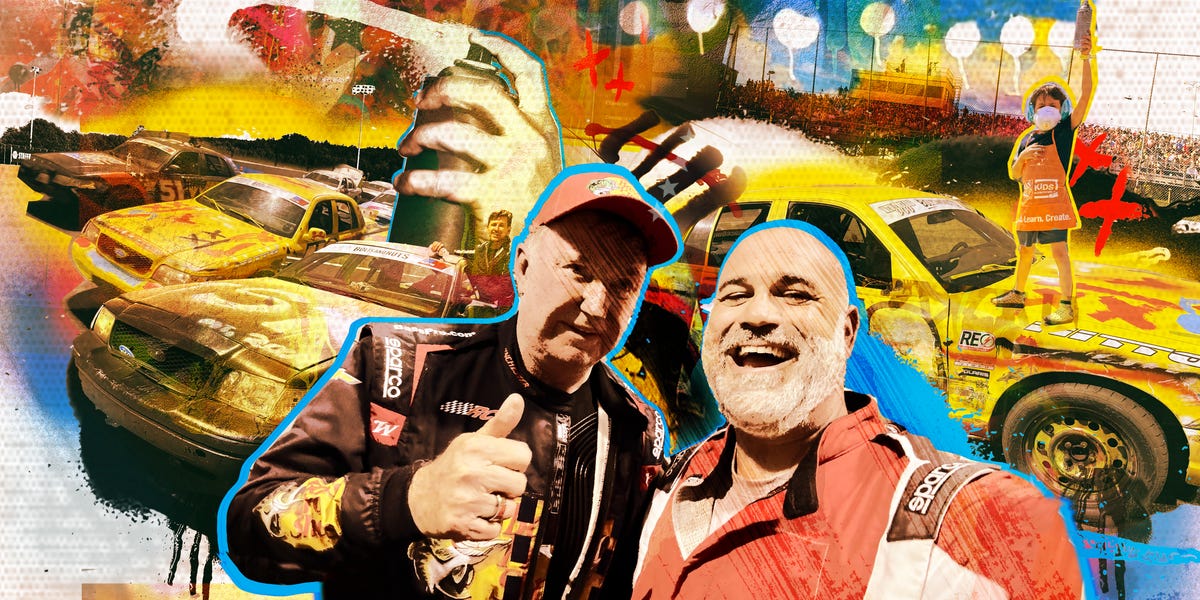
The cars are the key. McFarland's crew preps a fleet of identical post-2003 Ford Crown Victorias—the same model that served as America's taxi, police cruiser, and senior citizen special for decades. Each one gets a roll cage, a racing seat, a dry 50-shot of nitrous with a 10-pound bottle (good for about 60 seconds of spray), steel wheels, and Nitto tires. No mufflers. The team makes them as identical as possible, and the rules are absolute: you cannot check tire pressure, you cannot pop the hood, you cannot make any setup changes before the race. What you can do is decorate. I enlisted my 5- and 6-year-old nephews to paint my car, which resulted in a yellow base coat with an avant-kindergarten theme that stood out against the white walls and dark asphalt. The result of this spec formula is that the spread in qualifying times between first and twentieth place was less than one second. 'The Crown Vic is the great equalizer,' McFarland told me before the race. 'It's very hard to pass when the difference between you and a NASCAR pro is like a few tenths of a second a lap. That's when the racing gets a little aggressive. We don't hit, but we will move you out of the way.'
A Driver's Meeting Like No Other: 'There's People You Can Hit'
The writer had never heard the term 'blast radius' used in a driver's meeting. Nor had he heard a race promoter point at a NASCAR driver and say, 'There's people you can hit,' before gesturing to an 80-year-old Richard Childress and saying, 'And there's people you can't hit.' Childress, who founded Richard Childress Racing and won NASCAR races long before the writer was born, was there with his grandson, NASCAR Cup Series driver Ty Dillon. Also in the field: Ryan Preece, who won at Stafford last year, plus a mix of Late Model drivers and Formula Drift champions. The other half of the 24-car grid was made up of motorsport-adjacent influencers—the writer, Zack Klapman, BoostedBoiKyle, and others. The writer wasn't singled out as someone you can't hit, which felt like an oversight. The first time you put that 'Vic in 'D', you're a hundred yards from the starting line for qualifying. You get five laps: an out, three flyers, and a cool down, to learn the car, the line, and set a time. Someone ahead hit the wall on their first lap, so the writer's priority shifted from going fast to not doing that. He qualified P18, which was exactly where he wanted to be—hanging at the mid-back for an insane start.
The Undercard: Altimas, Minivans, and the Eight-Foot Jump
The main event didn't start until after two undercard races that were, by any measure, more chaotic. First up: a 40-plus car field of Nissan Altimas—you know, the default rental car and used lot staple—racing 40 laps around the one-eighth-mile infield course. The only apparent rule was that you had to buy a car on Facebook Marketplace, register it, insure it, and drive it to the track. Most of them never drove home. Maybe a third finished, and those that did were barely hanging on. Some of the drivers, McFarland told me, 'buy a car on Marketplace, register it and insure it, and bring it here to race, fully expecting to drive it home. Delusional, but you gotta love it. They're always going home in a rental.' Then came the Van Prix: minivans, uncaged and road-legal, with normal seats, seatbelts, and windows. To keep things interesting, the crew built a portable jump that, though it looks small, can launch a van eight feet into the air, only for it to nosedive into a completely flat landing. McFarland says this sport 'has a hard out at about 24 years old.' I asked one driver, still wearing jeans and a hoodie as he pulled off his helmet after flatlanding a dozen jumps, how it felt. 'Best day of my life, bro!' He was 20.
90 Laps of Metal-on-Metal: The Main Event
The main event was 90 green-flag laps. Over the next two and a half hours, 14 cars completed the distance, and ten died noble deaths trying. In any other racing series, contact means a black flag or worse. Here, the writer learned there is a 'correct' amount of crashing. You want to stay out there, but you also need to move people out of the way—and they'll use your car to make a corner, or as a wall. The writer's endurance racing background paid off: for 75 laps, he kept car 419's nose clean, weaving through spinning cars and sliding cars while the nearly dozen full-course yellows (which added an hour of runtime) let him reset and close up to the pack. The aggression got worse up front. Three restart crashes in a row prompted a lecture from race control. The most terrifying moment came when he zig-zagged around a spinning car only to find himself 50 meters from the driver's door of a perpendicular and sliding Richard Childress; his yellow nose pointed directly at the Earnhardt No. 3. Childress locked his brakes, and the writer managed not to hit the one guy he wasn't allowed to hit—though Childress apparently had no such restrictions, attempting to P.I.T. maneuver him at least twice and pushing him on restarts with nitrous twice more. The writer saved his nitrous for the last 15 laps, which he later learned was a mistake; the pros start spraying much earlier.
The Finish Line, the Fireworks, and the Future of Grassroots Racing
I crossed the line seventh, directly behind Bobby Earnhardt (nephew of Dale Jr.) and David Arute, the speedway's general manager, and just ahead of Richard Childress, who slipped into his Bass Pro Shops gear before posing for a photo. My car survived in reasonably good shape. The 7,000-plus crowd roared as we climbed out at the finish line—not because of our driving, but because McFarland had brought his own fireworks team from Florida, who rigged up a display that would be reserved for Jacksonville on the Fourth of July. Bombs burst overhead, raining shrapnel on the whole place. McFarland transitioned effortlessly from driver to post-race commentator, interviewing the top three finishers for the live stream. The economics are simple: $40 for a ticket, $20 for a single stream, $20 a month for everything. The production quality is on par with an IMSA broadcast. 'You really want to put on a show for people who want to see excitement out on the track but don't care about the intricacies of racing,' McFarland says. 'That's how you get the masses into it.' It's not a demolition derby—destruction isn't the point. But when cars die noble deaths chasing victory, you don't need to know who's leading to have a great time. They weren't kidding about the blast radius.