McLaren’s Manual Teaser Revives the F1’s Three-Pedal Legacy
A cryptic Monterey Car Week reveal puts McLaren’s manual-transmission history back in the spotlight, from a mystery road car to a Le Mans-bred F1 GTR.
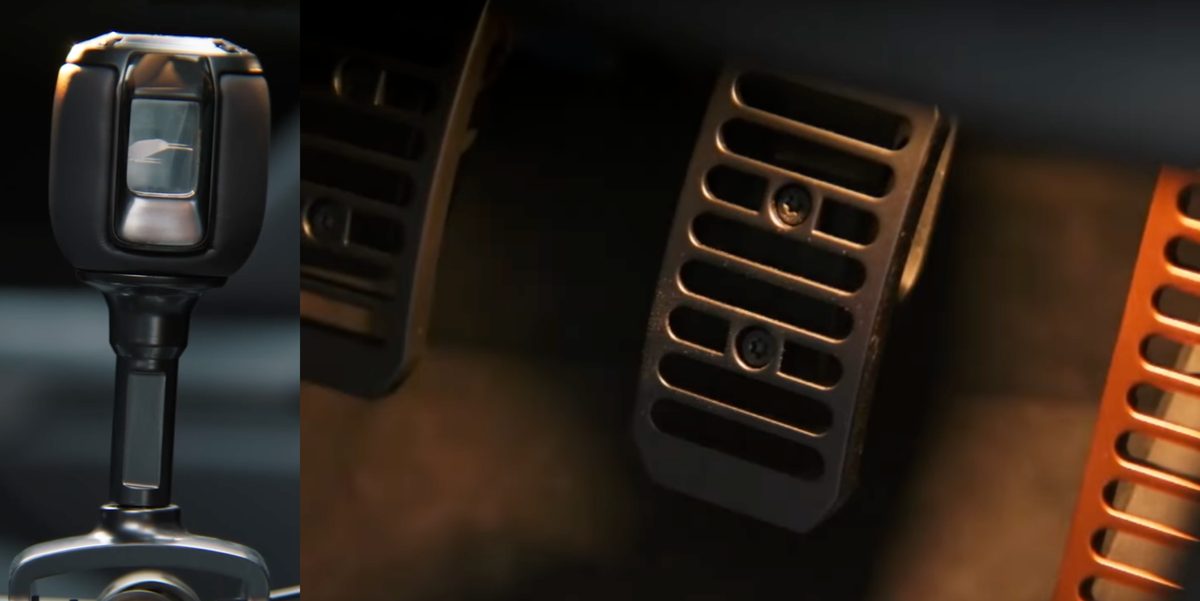
Three pedals, one unanswered question
McLaren’s latest teaser is built around a detail modern supercar buyers rarely see: three pedals. Posted Thursday morning ahead of a Friday reveal at Monterey Car Week, the video shows a sculpted gear shifter with the McLaren emblem appearing to float inside its glass-like knob. A second glimpse focuses on the pedal box, where an orange throttle sits beside bright-metal brake and clutch pedals.
The surrounding details are deliberately incomplete. Short shots show cherry-red paint, a fuel-filler cap, carbon fiber around an exhaust outlet, and flashes of LED lighting that could belong to either end of the car. None establishes the model. That restraint leaves the transmission as the central clue rather than a confirmed identification.
For drivers, the clutch pedal matters because it signals more than nostalgia. It suggests a car designed around physical control, but the teaser alone cannot establish whether the gearbox is a conventional manual or a system that imitates one electronically.
The gearbox remains the real mystery
McLaren has not yet answered the question that will define this car: what kind of manual transmission is actually being offered? A conventional gearbox would connect the clutch, gear lever, and engine through the mechanical decisions familiar to sports-car drivers. A simulated manual could reproduce those actions through software while leaving the underlying hardware automated.
Ferrari has already explored the second approach with the 12Cilindri Manuale, making the distinction more than a theoretical engineering question. The driver may see and operate a clutch pedal and shifter, yet the sensation, maintenance demands, and failure points can differ sharply from those of a true manual gearbox.
The teaser’s exhaust note provides another clue, but not a conclusion. Its sound most closely resembles McLaren’s V-8, while the visible fragments reveal no engine bay, body profile, or model-specific feature. Until the cover comes off Friday, the powertrain remains unconfirmed. The practical divide is clear even before the specification is: hardware determines service complexity, while software determines how convincingly the car can reproduce the rhythm of a manual shift.
The original McLaren manual was built for the road
McLaren’s most famous manual car began with a different ambition. Gordon Murray conceived the F1 as an ultimate road car, not a racing machine, and the production model used a BMW-sourced 6.1-liter naturally aspirated V-12, a six-speed manual gearbox, and rear-wheel drive. Its output exceeded 600 horsepower.
That combination made the F1 unusually direct: a large-displacement engine, a driver-operated transmission, and no electronic substitute for choosing the next gear. One prototype reached 240 mph in 1998, setting an official world record for the fastest production car at the time.
The F1’s design philosophy also separated it from the technology-first approach Murray associated with the Porsche 959. He had admired the Acura NSX’s automatic climate control, but the larger objective was a machine that felt alive rather than merely sophisticated. The result remains a benchmark because its performance came packaged with an interaction modern cars increasingly filter through software. A new McLaren manual, if genuine, would therefore revive a defining part of the company’s identity rather than add an isolated novelty.

A racing F1 carries a different kind of history
The F1 became a competition car only after customers pressed McLaren to race it. The resulting F1 GTR won the 24 Hours of Le Mans outright in 1995, despite the road car never having been intended for endurance racing. Only nine GTRs were built, giving the racing variant a scarcity that places it in a different market from any new showroom model.
Chassis 10R is especially notable. It was the first GTR constructed, competed at the 1995 Le Mans, and finished 20th overall before being converted for road use. McLaren later sold it to Pink Floyd drummer Nick Mason, whose collection includes a Ferrari 250 GTO and a Porsche 962.
The car retains the visual language of its era: a ketchup-and-mustard livery, fixed rear wing, reduced weight, and carbon-ceramic brakes intended for repeated circuit use. It also carries evidence of hard use, having been repaired by a U.K.-based specialist after two off-track incidents. RM Sotheby’s projected a sale above $35 million, a figure that reflects racing provenance as much as specification.