Ferrari Luce EV: Australian Orders Confirmed, Deliveries Due in 2027
Ferrari’s first battery-electric model has secured Australian buyers despite its controversial design, with strong performance claims and a long wait ahead.
When will the Ferrari Luce arrive in Australia?
The first Australian customer cars are planned for the fourth quarter of 2027, covering October through December. Ferrari Australasia president Michele Comelli confirmed that orders have already been placed and allocations secured in Australia and New Zealand. That leaves local buyers waiting more than a year for deliveries of the marque’s first fully electric model.
A preview car is scheduled to reach Australia in September, before customer vehicles arrive. Ferrari’s official dealer network will use that example for a series of exclusive events, giving prospective owners an opportunity to see the Luce locally ahead of handovers.
Comelli said interest came from existing Ferrari customers and people new to the brand, with orders in both markets placed immediately after the car’s world premiere in Rome.
Has the Luce already sold out?
Ferrari reportedly reached its 2026 Luce sales target less than two months after the model’s global unveiling. The Financial Times reported that the target was just under 500 examples, based on information from people familiar with the company’s internal forecasts. The allocation was described as sold out, although Ferrari has not disclosed a precise production figure.
The car carries a reported starting price of €550,000, equivalent to approximately A$898,000. That positioning places the Luce well beyond conventional luxury-EV territory and makes the speed of its sales notable even within Ferrari’s limited-volume business.
The manufacturer produced and delivered 15,451 cars during 2025, so the reported Luce target represents only a small share of its overall output. Production is expected to rise in 2026, but the early allocation result indicates that scarcity and the badge remain powerful factors for buyers willing to pay supercar money for an electric grand tourer.
How quick is the Ferrari Luce?
The Luce uses four electric motors, with one driving each wheel, and produces 772kW of power and 990Nm of torque. Ferrari claims it can accelerate from 0-100km/h in 2.5 seconds, reach 200km/h in 6.8 seconds, and continue to a top speed of 310km/h.
Those figures put the car firmly in performance-grand-tourer territory rather than treating electric power as a quiet efficiency exercise. The four-motor layout also gives the engineering team independent control at each corner, a configuration suited to managing the substantial output through all four tyres.
Ferrari has positioned the Luce as a technology showcase for customers already familiar with electric vehicles. Its acceleration claims are especially significant because the model is also designed as a five-seat, four-door car rather than a stripped-back two-seat sports machine. The published figures describe straight-line capability; they do not by themselves establish how the car behaves on Australian roads or in everyday traffic.
What battery and range does the Luce have?
The electric grand tourer is fitted with a 122kWh battery and an 800V electrical architecture. Ferrari says the battery is made in-house and that the Luce can travel more than 530km on the WLTP cycle.
The 800V system is a high-voltage foundation intended to support rapid energy transfer and sustained electrical performance. No Australian charging time or peak charging rate has been specified. Buyers therefore have a range claim, a battery capacity and a voltage architecture, but not a confirmed local charging schedule.
WLTP range is a laboratory figure rather than a guaranteed distance in every journey. Speed, temperature, road conditions, passengers and climate-control use can all affect an electric vehicle’s actual consumption. The published specification nonetheless gives the Luce a substantial touring brief, while its battery size reflects the demands of four motors and Ferrari’s performance targets.
Is the Luce practical enough for regular use?
The Luce is Ferrari’s first battery-electric vehicle and its first model with five seats. It is also only the second four-door production car in the company’s history, following the Purosangue.
That layout gives the car a broader role than Ferrari’s traditional two-seat or occasional-use sports cars. Rear-seat capacity makes it possible to carry more passengers, while the four-door body should provide easier access than a conventional coupe. Boot volume, rear legroom and child-seat compatibility have not been specified for Australian buyers.
The Luce is not intended to replace Ferrari’s combustion-engined models. Instead, the company is pursuing a multi-energy strategy in which petrol, hybrid and electric cars coexist. Its practical significance is therefore less about replacing a particular existing model and more about adding a usable, high-performance electric format to the Ferrari range.
How much does the Ferrari Luce weigh?
The Luce weighs 2260kg, a substantial figure shaped largely by its battery and electric hardware. Ferrari says the battery is mounted low in the vehicle, lowering the centre of gravity compared with the Purosangue.
The company also claims that its sophisticated suspension allows the Luce to handle and change direction like a car around 400kg lighter. That is an engineering claim about perceived dynamic performance, not a reduction in the vehicle’s actual mass. The scale reading remains 2260kg.
The low battery position can help reduce body movement and support stability, while suspension control can influence how readily a large vehicle responds to steering inputs. Those characteristics will matter more than the weight figure alone when the car is driven on Australian roads. Ferrari’s approach is to offset the mass of a large battery through chassis technology rather than disguise the vehicle as a lightweight sports car.

Why has the Luce’s design attracted so much attention?
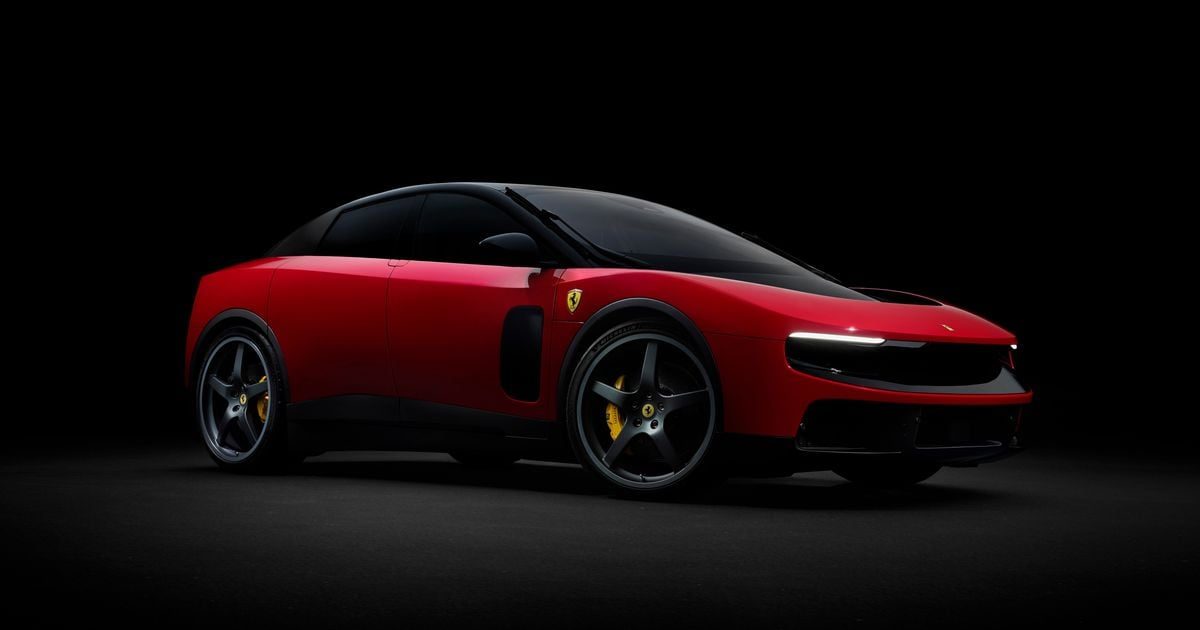
The Luce adopts a radically clean interpretation of Ferrari styling, with a large glazed glasshouse, floating aerodynamic wings and unusually smooth surfaces. The design was developed with LoveFrom, the creative collective founded by former Apple design chief Sir Jony Ive and Marc Newson.
That visual break from familiar Ferrari forms produced strong criticism when the car was revealed in Rome. Some enthusiasts and investors questioned whether its shape suited the famous prancing-horse identity, and former Ferrari chairman Luca Cordero di Montezemolo publicly suggested that the badge should be removed.
The market response was not uniformly negative. Ferrari’s share price fell more than eight per cent in the first trading session after the reveal, according to the Financial Times, but later recovered by more than 24 per cent and was reported at €353.60, or about A$577, per share. The controversy has not prevented wealthy customers from placing orders.