What an 11-Cylinder Engine Sounds Like, Measured on a Deactivated V12
Maisteer pulled one spark plug on a 6.0-liter V12 Mercedes SL to hear the odd-cylinder firing order that shouldn't exist.
Is a real V11 engine possible?
No. A true V11 would need one bank of five cylinders and the other of six, an uneven split that destroys the firing balance every V engine relies on. In a conventional V configuration, each bank holds an equal number of cylinders—6+6 for a V12, 5+5 for a V10—so the firing pulses alternate evenly between banks. A V11 would force a 5/6 split, producing uneven intervals that generate harsh vibration and stress on the crankshaft and block. That's why Maisteer—a YouTube channel that experiments with exhaust notes—used a 6.0-liter V12 in a modified R230 Mercedes-Benz SL as a stand-in. By deactivating one cylinder, they simulated a firing order no production engine has ever used, and later they ran the same engine as a V10 and a V9 by deactivating further cylinders, giving a range of impossible engine sounds. Another YouTuber once simulated an inline-11, which could theoretically work but would be too long to be practical. The V11 simulation, while not a real engine, gives enthusiasts a way to experience the exhaust note of a configuration that can never exist in production, and it does so without the engineering problems that would come with an actual 5/6 bank split.
How did Maisteer turn a V12 into a V11?
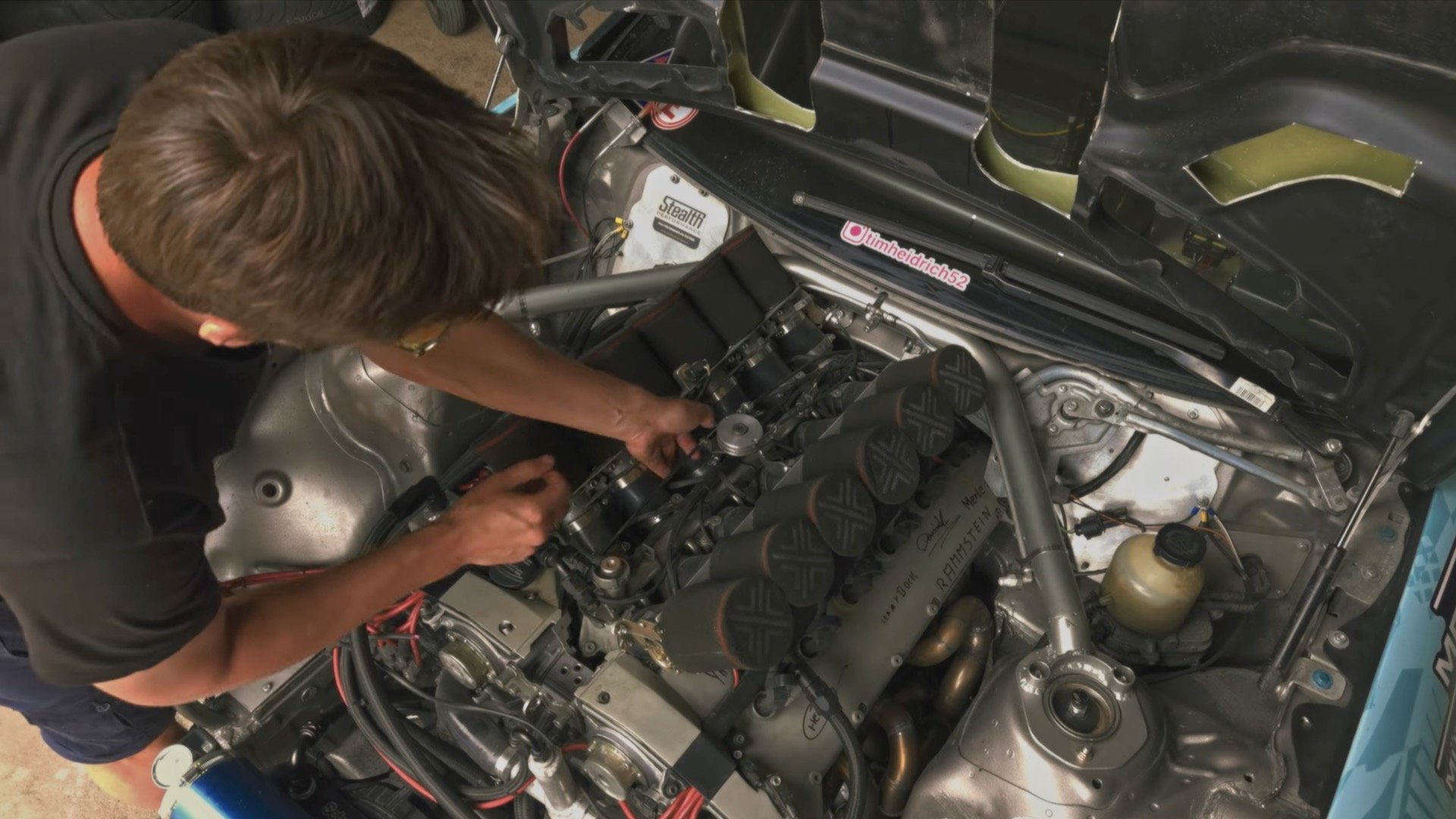
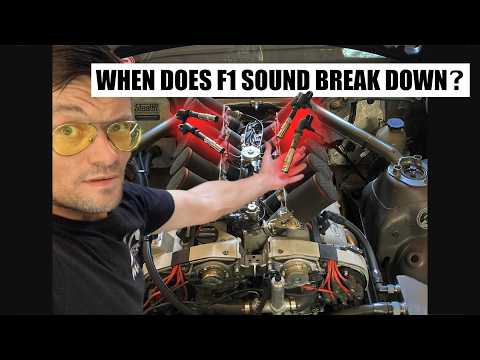
Maisteer pulled the spark plug wire on cylinder number three of the 6.0-liter V12 in their R230 Mercedes-Benz SL, forcing that cylinder to stop firing while the engine kept running. That left 11 active cylinders in a V-shaped block, mimicking the uneven bank counts of a theoretical V11. For subsequent runs, they deactivated cylinder ten to get a V10, then cylinder six as well to drop to a V9. Each deactivation was done in sequence, letting them record exhaust notes and frequency data at every stage. The modified Mercedes also wore a non-stock exhaust system, which made the engine shriek like a race car and likely masked some subtle differences between cylinder counts. This deactivation approach works because a V12's equal banks of six and six can be turned into an 11-cylinder firing pattern by disabling one cylinder, leaving a five-and-six bank split that approximates the impossible V11. Disabling a second cylinder gives a five-and-five split for a V10, and a third gives a four-and-five split for a V9. The specific cylinders disabled were three, ten, and six, in that order, to produce the V11, V10, and V9 sounds. The result is a full range of odd- and even-count engine sounds from a single V12 block.
Does a V11 sound different from a V12?
Barely, to most ears. Maisteer's recording of the 11-cylinder run showed only a slight unevenness from cylinder three not firing, but the overall tone was nearly identical to the healthy V12. Frequency-meter readouts, however, revealed genuine shifts at 400 Hertz and 800 Hertz—points where the cancellation and reinforcement of exhaust pulses changed because of the missing firing event. Those differences are real but subtle enough that they require an instrument to detect reliably. The non-stock exhaust on the car, which added a race-car shriek, may have drowned out some perceptible variation. The V11 didn't sound bad either—it kept the V12's deep, resonant character while losing a small amount of smoothness from the dead cylinder. The biggest separator is not the overall volume or pitch but the specific attenuation at 400 and 800 Hz, which a frequency meter catches even when the ear cannot. This means the acoustic gap between an 11-cylinder and a 12-cylinder is far smaller than the gap between, say, a V8 and a V12. In practice, the V11 loses the even, rhythmic pulse of a true V12, but the change is more like a minor hiccup than a fundamental transformation.

What do V9 and V10 configurations sound like compared to a V12?
As cylinders were deactivated, the exhaust note gained bass and lost high-frequency zing. Maisteer's runs from V12 to V11 to V10 to V9 showed that odd-numbered configurations like V9 and V11 didn't sound as bizarre as expected—the firing order still had enough overlap to keep a steady pulse. The bigger change came with range: the engine picked up more low-frequency rumble with each deactivation, and when the V12 was down four cylinders (running as a V8), it settled into that familiar, throaty V8 rumble. Frequency readouts made the differences clear even when ears couldn't always spot them, showing a steady shift toward lower dominant frequencies as cylinder count fell. For V10, the note loses some of the V12's high-frequency sheen but gains a deeper, more muscular undertone. For V9, the bass becomes even more pronounced, and the exhaust note takes on a gruff, uneven cadence because the firing intervals are no longer perfectly alternating between banks. The V8, with four cylinders disabled, is the most familiar—a deep, rumbling pulse that stands out from the higher counts.
Could an inline-11 engine ever work?
Theoretically, yes, but not in any practical vehicle. A fellow YouTuber simulated an inline-11 engine a few years ago, and the exhaust note was surprisingly good—smooth enough that it didn't sound broken. The problem is packaging: an inline-11 would need eleven cylinders in a single row, which makes the engine extremely long. It would never fit transversely in a normal car, and even longitudinally it would intrude into the cockpit or require a hood of absurd length. So while the firing order is acoustically viable, the physical layout kills the idea. The V11 simulation by Maisteer avoids that because the cylinders are split across two banks, but the uneven bank count is what rules out a real V11 in the first place.
Why does cylinder count matter so much for exhaust sound?
Exhaust note is largely a product of firing frequency and pulse overlap, which are set by how many times the cylinders fire per revolution. A V8 fires eight times per two rotations, a V10 ten, a V12 twelve—more cylinders mean more evenly spaced pulses and a smoother, higher-pitched wail. That's why V6 and V4 engines often sound coarse or buzzy, while eight or more cylinders produce the deep, musical tones enthusiasts love. Odd numbers like eleven or nine create uneven gaps between pulses, which can add a slight irregularity—but as Maisteer's tests show, the effect is small when the total count is high. The real drop happens when you lose enough cylinders to cut pulse frequency significantly, which is why a V8 still sounds so distinct by comparison.
How are automakers recreating engine sounds for electric cars?
Engine sounds are foundational to car character, which is why automakers are stressing about how best to replace that chorus in electric cars. Hyundai has already developed a sci-fi soundtrack for its electric N models, offering a futuristic alternative to traditional combustion tones. Bentley, meanwhile, thinks drums are the best option for its Torcal electric SUV, suggesting a percussive rhythm rather than a melodic hum. BMW blended sounds from a number of sources for its Neue Klasse EVs, combining elements to craft a unique auditory identity. These three approaches illustrate the range of possibilities automakers are exploring as they seek to give electric vehicles a distinctive acoustic signature. The willingness to experiment with unconventional sound sources shows how crucial this aspect of car character has become in the electric era.