Hennessey's Blackbird Hypercar Has No Screens, a Gated Six-Speed, and a 6.2-Liter V-8
The carbon-fiber hypercar stays under 3,000 pounds dry, limits electronics to ABS and traction control, deploys active stabilizers at 71 mph, and includes a phone holster, four cupholders, and space for two carry-ons—debuting at The Quail.
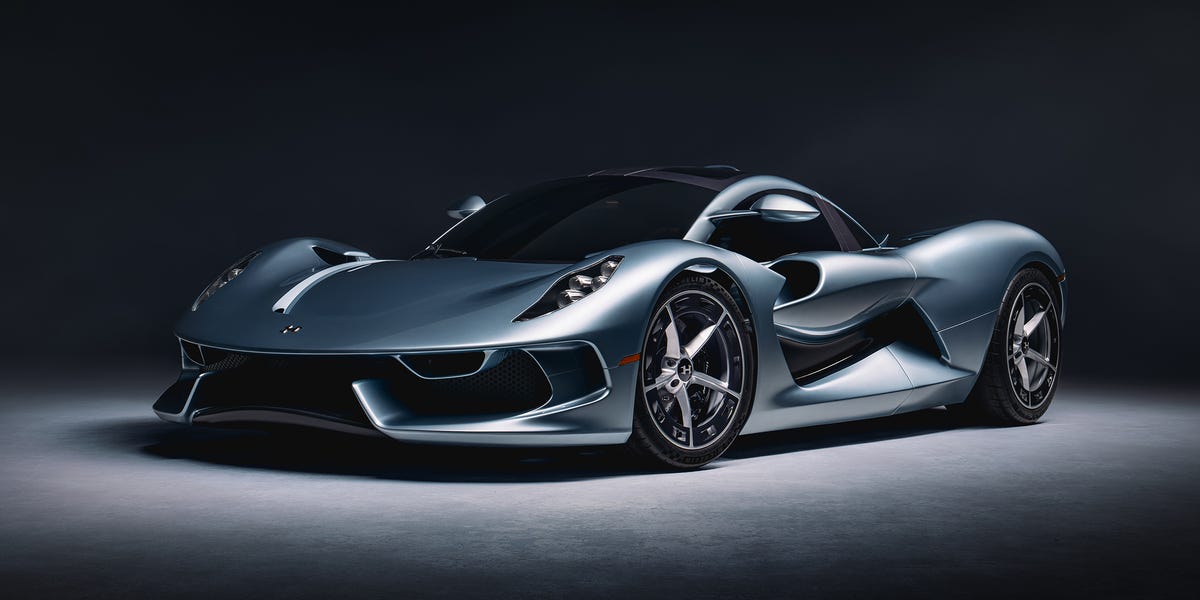
A 6.2-Liter N/A V-8 With a Gated Six-Speed
Hennessey's Blackbird is built around an engine that sounds like a bet against downsizing: a naturally aspirated 6.2-liter V-8 developed with Ilmor Engineering. The target is 800–850 horsepower, and Hennessey claims a redline north of 9,000 rpm. Power routes through a gated six-speed manual to the rear wheels—no paddles, no all-wheel drive, no hybrid assist. This is a deliberate contrast to the turbocharged, record-chasing Venom GT and F5 models. The high output from a non-aspirated 6.2-liter is a significant engineering hurdle, which explains the Ilmor collaboration. For a hypercar, this is a powertrain configuration that prioritizes engagement over efficiency. It also sets the Blackbird apart from anything else at its price point, promising a driving experience that depends on keeping the revs up rather than a boost curve.
- Engine6.2L naturally aspirated
- Performance800-850 hp
- Transmission6-speed manual
Sub-3000-Pound Dry Weight From Carbon Fiber Everything
Hennessey claims a dry curb weight of under 3,000 pounds, a figure that would put the Blackbird in a class of its own for a combustion hypercar. That lightness comes from a bespoke carbon tub and extensive carbon fiber bodywork. The suspension is inboard-mounted—a racing approach that reduces unsprung mass—and paired with adaptive dampers. Michelin Pilot Sport Cup2 tires are standard, mounted on one of two wheel designs Hennessey will offer. The low mass and sticky tires are key to the car's performance figures. More importantly, sub-3000 pounds makes the car feel agile and responsive, which is the whole point of a driver-focused machine. The dry weight figure likely excludes fluids. This is a case where sacrificing luxury features for lightness pays off directly in the driving experience.
- Weightunder 3,000 lbs dry
- Chassiscarbon tub
- Chassisinboard suspension
2.5 Seconds to 60 mph, 220 mph Top Speed
While Hennessey says the Blackbird isn't about numbers, it still posts some impressive ones. The 0-60 mph sprint takes just 2.5 seconds, and the top speed is 220 mph. These figures are all the more remarkable given the naturally aspirated V-8 and manual gearbox—most hypercars rely on turbos and dual-clutch automatics to achieve such acceleration. The claimed sub-3000-pound dry curb weight, achieved with a bespoke carbon tub and carbon fiber bodywork, is a key factor here; so are the Michelin Pilot Sport Cup2 tires, which wrap one of two available wheel options. The driver must work the gated six-speed manual, and the active vertical stabilizers deploy at 71 mph, sitting at +/- 71 degrees, while the quad exhaust mimics the Bell X-1. Hennessey doesn't release quarter-mile times, but given the 60-mph figure and the power-to-weight ratio, it's likely to be in the high-9s. The top speed is limited by gearing and aerodynamic drag, but 220 mph is plenty for a road car.
- Performance0-60 in 2.5 sec
- Performancetop speed 220 mph

Traction Control and ABS Are the Only Electronics
The Blackbird's cockpit is a refreshingly simple place, and that philosophy extends to its control systems. Hennessey fits traction control and anti-lock brakes, and that's it—no launch control, no torque vectoring, no stability control beyond that. This is a deliberate choice to keep the car engaging and to trust the driver. The traction control is likely adjustable or even defeatable, though Hennessey hasn't specified. This approach mirrors the best driver's cars of the past, but with modern tire and damper tech. That design choice states plainly that driving skill still matters. The absence of a complex electronics suite also saves weight and reduces the chance of software glitches. Inside, there are no screens; the experience centers on a large tachometer, an exposed shifter linkage, and a physical ignition key. Instead, a 'Hennessey holster' holds your phone, which becomes the infotainment center. It's a back-to-basics approach that should reward those who learned to heel-toe.
- Controlstraction control only
- ControlsABS only
Active Vertical Stabilizers Deploy at 71 mph
The Blackbird's name comes from the SR-71 Blackbird spy plane, and the design follows through. Hennessey fits active vertical stabilizers that deploy at 71 mph and sit at +/- 71 degrees—a direct nod to the aircraft's designation. These aren't just styling gimmicks; they likely aid in high-speed stability or downforce, though Hennessey hasn't detailed their function. The quad exhaust exit is another aviation-inspired touch, said to mimic the Bell X-1's exhaust ports. The bodywork overall has a clean, slightly retro-futuristic look that manages to evoke the military jet without being kitschy. The 71-mph activation point is a whimsical detail that will delight owners every time they hit that speed. For a hypercar that's supposed to be about driving, these design elements tie the experience to a legacy of speed and precision. The lack of a rear wing (at least in the images) suggests the stabilizers might be the main active aero element.
- DesignSR-71 inspiration
- Designstabilizers at 71 mph
- Designquad exhaust mimicking B
No Screens, but a Physical Key and a Phone Holster
Inside the Blackbird, there is not a single screen—no digital instrument cluster, no infotainment touchscreen. Instead, you get a large central tachometer, exposed linkage for the gated shifter, and a physical ignition key that you turn to start the car. This is a radical move in 2025, but Hennessey designed it to be timeless and distraction-free. However, if you need navigation or audio, there's a "Hennessey holster"—a mounting point for your phone that pairs with the car's hidden technology system. So you bring your own device and slot it in as the infotainment. The interior also focuses on visibility, with a low cowl and thin pillars. It's an environment that prioritizes mechanical connection over digital overlays. The exposed shifter linkage is a visual treat, showing the rods and detents working as you change gears. For buyers who lament the loss of analog cockpits, this is the antidote.
- Interiorno screens
- Interiorphysical ignition key
- Interiorcentral tachometer
Four Cupholders and Space for Two Carry-Ons
Despite its track-focused mission, the Blackbird is designed for road trips. Hennessey engineers spent significant effort on NVH—noise, vibration, and harshness—to keep the cabin comfortable at high speeds. The front trunk accommodates two small carry-on bags, and there are rear luggage pods for extra storage. In a nod to American road-trip culture, the car features four cupholders, each sizable enough for a large drink. This is surprising for a hypercar, but Hennessey clearly wants owners to actually drive it long distances. The adaptive dampers likely have a comfort mode, and the manual gearbox has a light-enough clutch for stop-and-go traffic. The combination of a spacious interior (for a hypercar) and practical storage makes the Blackbird a potential daily driver, as long as you can handle the attention. The emphasis on NVH suggests Hennessey tested on rough pavement and at highway speeds to ensure the carbon tub doesn't drone or rattle.
- Practicalityfront trunk for tw
- Practicalityrear luggage pods
- Practicalityfour cupholders
Public Debut at The Quail, a Motorsports Gathering
The Blackbird will be publicly revealed at The Quail, a Motorsports Gathering, on August 14. This event is part of Monterey Car Week and is known for showcasing the most exclusive and high-end vehicles. Hennessey chose this venue to present the car to a select audience of collectors and enthusiasts. The Blackbird will be one of the highlights, given its unusual combination of a naturally aspirated V-8 and a manual gearbox. The Quail is invitation-only, but photos and coverage will be widespread. For those who win an allocation, this will be the first look at a car that won't enter production until 2029. The event is a fitting launchpad for a machine that celebrates analog driving in an increasingly digital world. Hennessey will likely bring prototypes and possibly allow walk-arounds, though driving demonstrations are unlikely at this stage.
- DebutAugust 14 at The Quail