Lamborghini's Revuelto Miura 60° Homage: A 1,001-HP Hybrid in 1966 Clothing
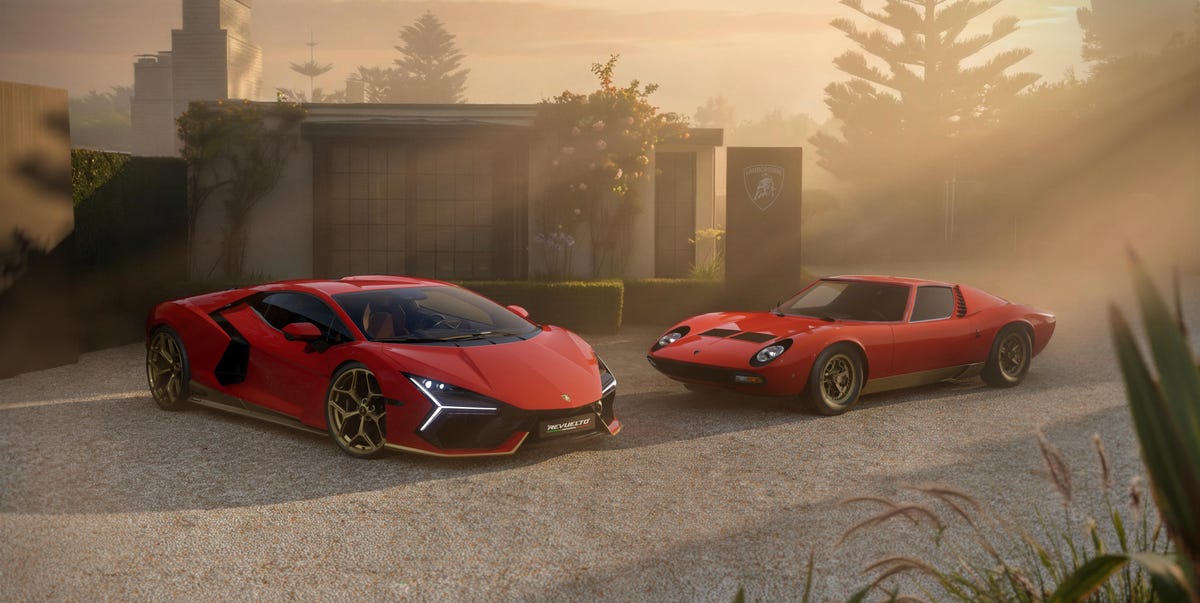
Ninety-nine examples will reach owners, each loaded with callbacks to the original Miura—from period paint codes to matching-owner-color programs to a silhouette that never quite left Sant'Agata.
99-unit production run locks in collector scarcity
Lamborghini will build exactly 99 Revuelto Miura 60° Homage examples worldwide. Each car carries a carbon-fiber plaque on the driver's door sill engraved with its individual build number and the 60th-anniversary logo, making every unit traceable and distinct. The mechanism is straightforward: once all 99 plaques are assigned, production ends. There is no second run, no expanded allocation, no later variant that dilutes the count. For buyers, that cap shapes the entire ownership experience. A numbered plaque means the car's provenance is verifiable from the factory, a detail that matters at resale because documentation of originality typically drives collector premiums. The 99-unit figure also determines how the car trades on the secondary market: when demand exceeds supply by a wide margin, owners can expect to sell above sticker without waiting for the model to age. Lamborghini has used this exact playbook before, producing small runs that sell out before public debut, and the Homage follows the same pattern. A buyer tracking residual value should consider the cap the single most important data point: the number is fixed, the interest is global, and the window to secure an allocation is finite.
Nine factory colors drawn from the original Miura palette
The Homage arrives in nine exterior shades drawn from the Miura's original options list, a palette that dates to the car's 1966 debut as the fastest production vehicle in the world at 174 mph. The roster includes Rosso Arancio, Giallo, Verde Scandal, Blu Tahiti, Blu Notte, Nero Noctis, and several other period-correct tones. Each modern tint has been developed to match its 1966-era counterpart as closely as current paint technology allows, so a Rosso Arancio Homage should read as the same red that left the Sant'Agata Bolognese factory six decades ago. The nine colors give collectors enough range to replicate nearly any well-known Miura specification without resorting to a custom order, covering the spectrum from bright single-tone finishes to deeper, more restrained hues. For buyers whose ideal shade falls outside the standard nine, Lamborghini's Ad Personam customization program can recreate a specific Miura's exact color combination on the Homage, turning the anniversary car into a direct chromatic match for an existing original. The factory palette alone, however, should satisfy most collectors: the selection is broad enough to honor the Miura's variety while narrow enough to keep each color rare within the 99-car run.
Two contrasting liveries recall the Miura's signature two-tone look
On top of the nine solid colors, Lamborghini offers two lower-body liveries inspired by the two-tone finishes many original Miuras wore from the factory. The Oro Elios treatment pairs a gold stripe along the rocker panels with Altanero Shiny Gold wheels, giving the car a warm metallic accent that runs from front to rear along its lowest edge. The Grigio Nimbus option swaps gold for silver, combining a grey lower stripe with Altanero Matt Titanium Diamond-cut wheels for a cooler, more understated effect. Both liveries hide a small "Miura 60" badge inside the stripe near the rear wheel arch, a detail that only appears on close inspection and rewards owners who know where to look. The two-tone approach mirrors how the original Miura used contrasting lower-body color to break up its silhouette and emphasize the car's width, a visual trick that made the low-slung body appear even wider than it was. By offering the liveries as factory options rather than aftermarket additions, Lamborghini ensures the stripe, badge, and wheel finish are covered under warranty and integrated into the car's build documentation from the start. A buyer choosing between Oro Elios and Grigio Nimbus is essentially selecting between gold and silver accents, a decision that shapes the car's character as much as the base color beneath it.
Gloss-black rear badge mirrors the original car's placement
A gloss-black Lamborghini script logo sits centered on the Homage's rear decklid, positioned exactly where the badge appeared on the 1966 Miura. The placement is deliberate: the original car wore its nameplate as a quiet statement rather than a shout, and the Homage replicates that restraint. Black brake calipers and matte-black exhaust tips complete the monochrome treatment at the rear, replacing the standard Revuelto's bright-finished hardware with components that recede into the bodywork. The tonal shift draws the eye toward the car's sculpted surfaces rather than its mechanical components, echoing the Miura's original emphasis on form over flash. The gloss-black script against the body color creates a subtle contrast that reads as intentional without competing with the livery stripe or the color itself, letting the rear profile carry the same clean line the 1966 car is remembered for. For buyers who value visual cohesion, the blacked-out hardware means the rear end presents a unified surface: badge, calipers, and exhaust tips all share the same finish, eliminating the metallic highlights that can fragment a car's rear view. The approach is consistent with the Homage's broader design philosophy of using restraint to honor the original rather than adding visual noise.
Seats revive the Miura's upholstery pattern
Inside, the front seats feature a modern reinterpretation of the Miura's original upholstery pattern, a series of horizontal ridges that gave the 1966 cabin its distinctive textured character. The quilting runs across the seat surfaces in a pattern closely matched to the historic design, so a driver familiar with the original Miura should recognize the reference immediately. Leather extends well beyond the seats themselves, covering the dashboard, door panels, center console, and the rear bulkhead ahead of the firewall, creating a more cohesive leather environment than the standard Revuelto offers. An embroidered "Miura 60" logo sits on the leather panel between the two front seats, marking the anniversary without cluttering the cabin with multiple badges. The carbon-fiber plaque on the driver's side door carries the 60th-anniversary logo and the car's individual build number, tying the interior to the exterior's numbered distinction. The combination of period-correct seat patterning and extensive leather coverage gives the Homage cabin a warmer, more tactile feel than the standard car, which relies on a mix of materials that can read as more contemporary than classic. For buyers drawn to the Miura's interior character, the Homage offers a direct visual link to the 1966 car's cabin without resorting to retro styling that would feel out of place in a modern supercar.
Ad Personam lets original Miura owners match their exact color
Buyers who already own an original Miura can work with Lamborghini's Ad Personam factory customization program to replicate their car's specific color combination on the Homage, creating a matched pair that spans six decades. The process goes beyond the nine standard colors: Ad Personam specialists can reproduce any factory shade from the Miura's original options list, matching paint codes and interior specifications to the owner's existing car. That means a collector with a rare Verde Metallic Miura, for example, can commission a Homage in the identical green, with the same interior leather tone, so the two cars sit side by side as a visual timeline of Lamborghini's V-12 lineage. The program handles the full spectrum of customization, from exterior paint to interior materials, allowing owners to dictate details that standard production cannot accommodate. Because the Homage is limited to 99 units worldwide, an Ad Personam commission carries an additional layer of distinction: not only is the car one of 99, but its specific color combination may be unique within that already small run. The option is particularly valuable for collectors who have spent years maintaining a Miura in its original specification and want the anniversary car to honor that investment. Working through Ad Personam also means the custom color is documented in the car's factory records, preserving provenance that matters at resale and ensuring the match is verifiable decades from now.
1,001 hp and a 2.2-second sprint connect two eras of V-12 performance
The Homage uses the standard Revuelto's plug-in-hybrid powertrain: a naturally aspirated 6.5-liter V-12 working alongside three electric motors for a combined 1,001 horsepower. Lamborghini quotes a 0-to-60-mph time of 2.2 seconds, a figure that places the modern car in a different performance universe than its ancestor. The original Miura, released in 1966 with a screaming V-12, produced 380 horsepower and reached 62 mph in 6.7 seconds with a top speed of 174 mph, a benchmark that made it the fastest production car in the world at the time. Six decades later, the Miura's 6.7-second sprint to 62 mph is no longer mind-blowing, but the number remains significant as a marker of how far V-12 performance has traveled: from 380 hp to 1,001 hp, from 6.7 seconds to 2.2, from a single engine to a hybrid system that adds three electric motors to the mix. No mechanical changes differentiate the Homage from the standard Revuelto, so the anniversary edition delivers identical performance to any other Revuelto on the road. The powertrain connection between the two cars is the V-12 itself: both Lamborghinis are built around a naturally aspirated twelve-cylinder engine, a configuration the company has maintained across six decades while adding electrification to meet modern performance demands. For a buyer, the numbers tell a story of continuity and evolution: the V-12 remains at the heart of Lamborghini's flagship, but the surrounding technology has transformed what that engine can achieve.
Pricing is unconfirmed but the $608,358 base Revuelto sets the floor
Lamborghini has not announced pricing for the Miura 60° Homage. The standard Revuelto starts at $608,358, making that figure the baseline from which any Homage premium will be calculated. Given the Homage's 99-car production cap, its nine historic color options, and its bespoke interior treatments, a price above $700,000 is a reasonable expectation. The mechanism driving that premium is scarcity: with only 99 units available worldwide, demand is likely to outstrip supply from the moment allocations open, and secondary-market prices could climb further once the initial run is spoken for. For a buyer weighing the Homage against a standard Revuelto, the price difference buys exclusivity, a numbered carbon-fiber plaque, interior leatherwork matched to the Miura's original pattern, and access to the Ad Personam program for custom color matching—features the base car does not offer. Final pricing will likely surface after the Homage's public debut, where Lamborghini can gauge buyer interest and adjust accordingly. The $608,358 starting point gives collectors a reference for the minimum cost of entry, while the 99-unit cap and the car's historic ties to the Miura suggest the actual figure will be meaningfully higher.
Monterey Car Week serves as the public debut venue
Lamborghini will show the Revuelto Miura 60° Homage for the first time at its lounge during Monterey Car Week, the annual California gathering that hosts the Pebble Beach Concours d'Elegance and multiple high-profile collector car auctions. The event draws exactly the audience most likely to commission one of the 99 examples: buyers with the means and the automotive passion to appreciate the Miura's six-decade legacy. Monterey's concentrated schedule of events—concours, auctions, manufacturer displays, and private viewings—gives Lamborghini a week-long platform to present the Homage to collectors in a setting where rare and limited-production cars are the norm rather than the exception. The venue also allows prospective buyers to see the car in person, compare its nine historic colors and two liveries side by side, and discuss Ad Personam options with Lamborghini representatives on site. For a 99-unit model tied to a specific anniversary, the timing and location are strategic: Monterey concentrates the global collector market into a single geographic area over several days, maximizing exposure to the buyers most likely to act.