Telo’s 152-Inch EV Pickup Claims Full-Size Towing Muscle
The compact Telo MT1 is targeting an 8,000-pound tow rating, four-door practicality, and production later this year.
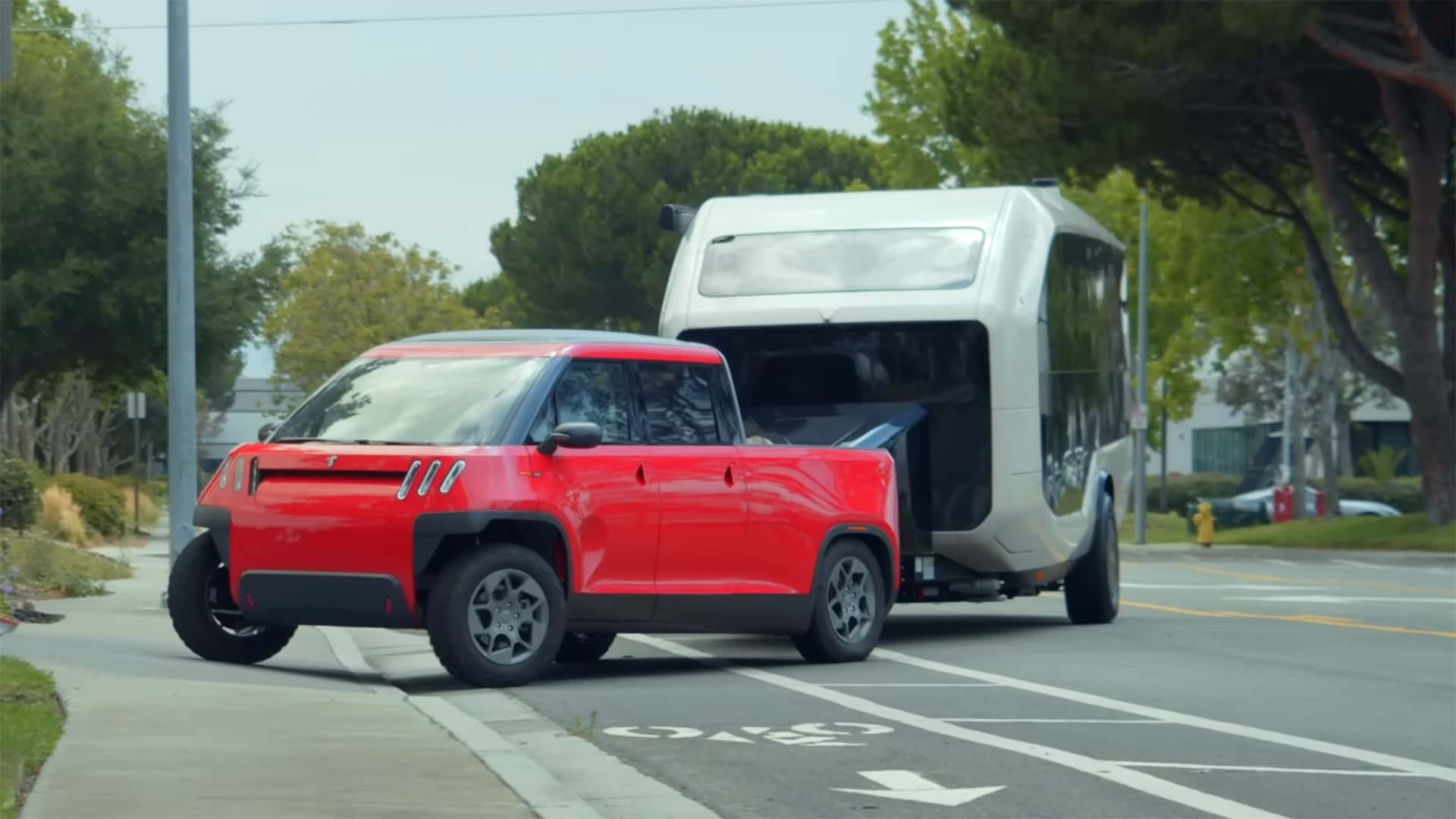
A Tiny Truck With an Eight-Thousand-Pound Ambition
Telo’s MT1 is small enough to invite comparisons with a city car, but its latest towing target belongs in full-size pickup territory. Cofounder and chief technology officer Forrest North said the four-door electric truck is now planned to tow up to 8,000 pounds, raising the company’s earlier target of 6,600 pounds.
The claim gives the MT1 an unusual role in the electric-truck market. At 152 inches long, it is about the same length as the latest-generation Mini two-door hatchback. Yet Telo has designed space for four doors, seating for as many as five occupants, and a 60-inch cargo bed.
That combination is the central argument for the vehicle: maneuverability in dense urban areas without abandoning the basic utility expected from a pickup. The towing figure remains a company claim, however. Telo has not yet put the truck into mass production, so buyers cannot independently verify the finished vehicle’s capacity or road behavior.
Why the Trailer Matters as Much as the Truck
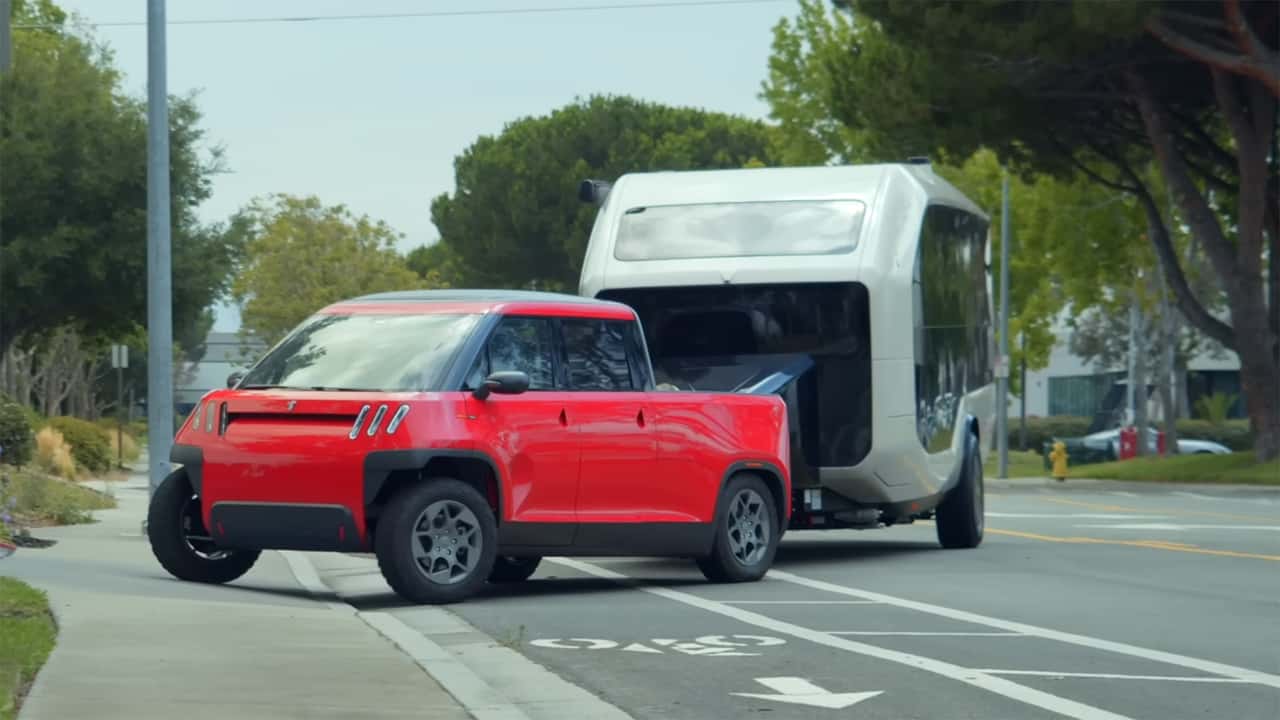
Telo’s higher rating is aimed partly at a new class of trailers that bring their own electric hardware. North described the benefit in a YouTube video showing the MT1 towing a Pebble Flow camper.
The Pebble Flow carries a 45-kilowatt-hour battery pack and two hub motors, with a gross weight of 6,800 pounds. Its onboard system can contribute propulsion and regenerative braking, reducing the conventional truck’s burden during a tow. That distinction matters for electric pickups, where hauling a heavy trailer can sharply increase energy demand and complicate braking on descents.
The MT1’s electric motors also provide regenerative braking, which Telo says supports the new limit. The company lists the truck’s own weight at 4,400 pounds. That mass, combined with the trailer’s active systems, forms the mechanical and electrical basis for the advertised 8,000-pound capability rather than making the claim solely a matter of motor output.
The Short Wheelbase Is Doing Real Engineering Work
The MT1’s compact dimensions are not only a styling decision. Telo says its bespoke electric platform lets the engineers position the axles close to the vehicle’s front and rear ends, leaving more usable length for the passenger compartment.
That layout also affects trailer loading. North said the short distance between the rear axle and tow hitch reduces the levering force that can unload the front end when a trailer is attached. In practical terms, the hitch sits closer to the axle carrying the trailer’s tongue weight, which can improve the truck’s stance under load.
This arrangement does not erase the other constraints that govern towing. Hitch weight, trailer balance, payload, tires, road grade, and stopping conditions still determine how a loaded combination behaves. Telo’s architecture addresses one geometric problem, while the final production vehicle will have to demonstrate how that solution interacts with its suspension, brakes, cooling systems, and battery management.
The Numbers Put the MT1 Against Bigger Rivals
The claimed capacity would place the MT1 above the entry versions of two familiar electric and gasoline-powered competitors. A base 2026 Ford F-150 with the 2.7-liter V6 EcoBoost and standard axle ratio is rated to tow between 7,400 and 7,600 pounds. Tesla’s base Cybertruck Dual-Motor is rated at 7,500 pounds.
Those comparisons apply only to the specified lower-capacity configurations. Ford and Tesla also offer versions rated to tow 11,000 pounds or more, so the MT1 would not challenge the upper end of the full-size pickup market. Its distinction is the proposed combination of towing strength and unusually short overall length.
Pricing adds another point of contrast. Telo estimates a $41,520 starting MSRP for a rear-motor model with 260 miles of estimated range. The company also plans a $50,000 dual-motor all-wheel-drive version with 350 miles of estimated range. The less expensive configuration is roughly $2,000 above the cheapest two-door F-150 and about $30,000 below the base Cybertruck.
Production Is the Remaining Test
The MT1’s specifications are still prospective because Telo has not begun mass production. The company recently announced a manufacturing agreement with Schwab Industries, a Tier 1 automotive supplier, for body-in-white production. Telo says vehicle production is scheduled to begin at the end of this year.
That milestone will determine whether the compact platform can deliver more than an impressive specification sheet. A production pickup must preserve its tow rating while meeting requirements for thermal control, braking, hitch structure, battery durability, crash protection, and payload. It must also support the repair and service demands that follow when an electric truck is used as an urban work vehicle rather than a commuter car.
For now, the MT1’s strongest case is its unusual packaging: a 152-inch footprint with four doors, seating for five, and a 60-inch bed. The next meaningful evidence will come when customer-ready trucks establish how those promises hold together outside Telo’s own demonstrations.