The V16 That Disco Built: Inside the Cizeta-Moroder's Second Act
Chassis No. 1, the prototype that carried Giorgio Moroder's name and a transverse V16, heads to Monterey with a $1.8 million estimate and a story that outlived its maker.
A Name That Never Quite Fit
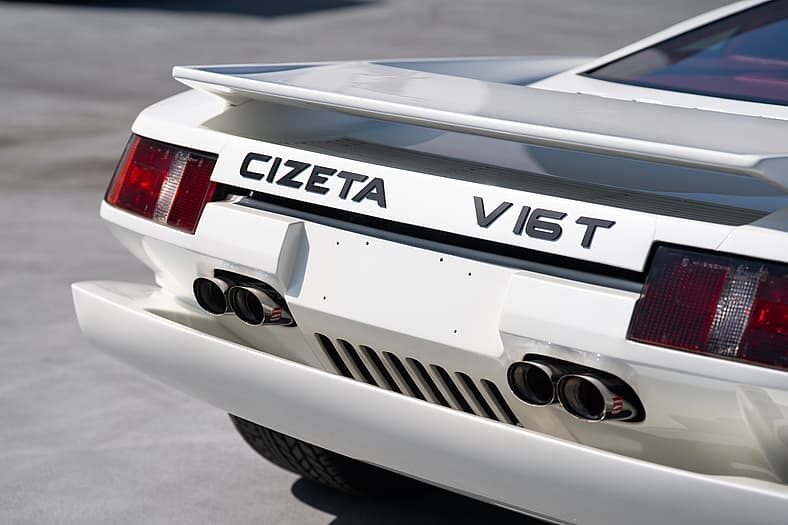
The badge on the rear deck reads Cizeta-Moroder, a pairing that always sounded like a collision between a machine shop and a recording studio. Claudio Zampolli, a Lamborghini test driver who ran a Los Angeles exotic car service center, wanted to build his own supercar. He had the engineering pedigree and the contacts, but he needed funding. Giorgio Moroder, the producer who had defined the disco era with hits like Donna Summer's "Love to Love You Baby" and "On the Radio," walked into Zampolli's shop one day. The two shared a passion for fast cars, and that meeting produced one of the most unusual joint ventures in automotive history.
The prototype, chassis No. 001, was unveiled at a glamorous 1988 event hosted by Jay Leno, scored by an original Moroder song titled "A Car is Born." The name on the car made sense at the moment. Moroder was the man whose sound had conquered the charts and who had picked up Oscar statuettes for "Danger Zone" and "Take My Breath Away" from Top Gun. Zampolli had the technical vision. The partnership looked like a fusion of the motor city and the dance floor.
Gandini's Angle
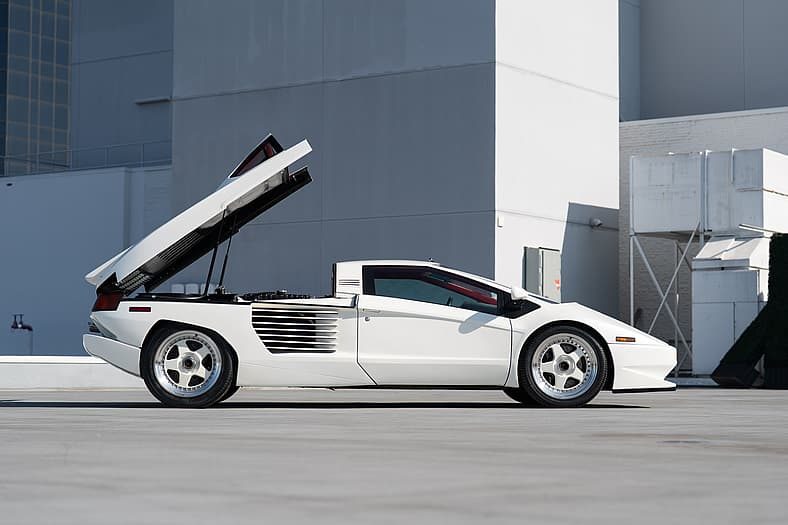
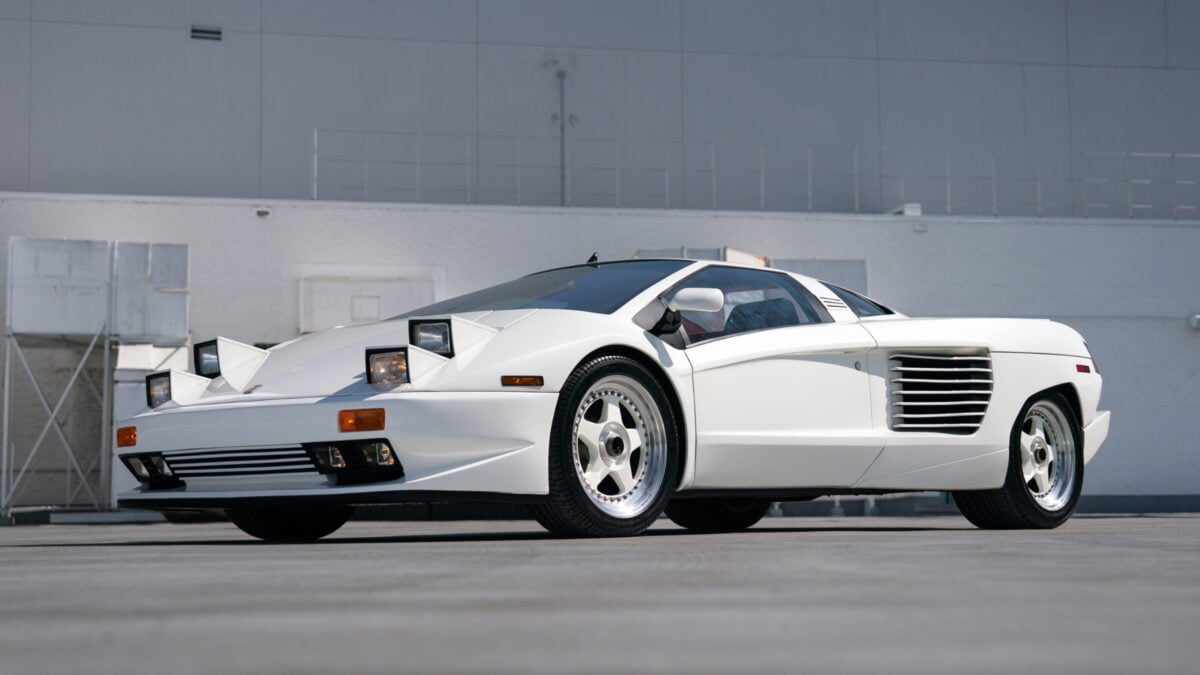
The body that Marcello Gandini sculpted for the V16T reads as a Countach pulled through a prism. Grandini, who had designed the Miura and the Countach for Lamborghini, gave his new creation sharper lines, perhaps even more angular than the machines that had made him famous. It is unmistakably his work, but the proportions tell a different story. The engine, a 6.0-liter V16, sits transversely in the middle of the chassis, a layout that had been abandoned after the Miura for the longitudinally mounted units that Lamborghini still uses today. Zampolli wanted the transverse arrangement for reasons of packaging and cooling. The result is a supercar that looks like the future as imagined in 1988, bristling with strakes and creases where no other machine had them.
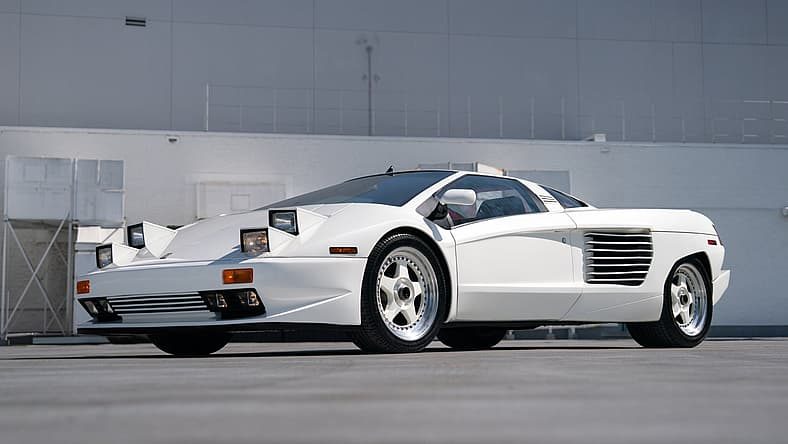
The prototype featured larger side air intakes with more strakes than the production cars, a diagonal crease in the lower bodywork that tied into the rear bumper, and unique turn signals and fog lamps. Gandini's sharp-edged style found its perfect expression in this low, wide shape that still looks radical decades later.
The Studio and the Test Track
Moroder met Zampolli in the latter's Los Angeles shop, and their mutual enthusiasm for exotic machinery spurred the project. The V16 was mounted transversely, an echo of the Miura's layout that Lamborghini later abandoned for longitudinal balance. At the 1988 unveiling, Jay Leno hosted, and Moroder contributed an original song, 'A Car is Born.'
The Prototype's Private Life
Although Moroder left the business, he kept the chassis No. 1 prototype. He held onto it for decades. While Zampolli struggled to move the other eight cars, Moroder retained his personal supercar, eventually commissioning a full restoration shortly before the car left his hands in 2022.
That sale, handled privately, brought $1,363,500. The new owner also received a package that extended beyond the car itself: an NFT including a four-track EP exclusive to the vehicle, a 3D artistic rendering created in collaboration with digital artist "Soulajit," a 3D scan of the machine, and digitized provenance documentation. The auction house handling the sale, RM Sotheby's, took the unusual step of selling the car with its digital companion. The original prototype is fully functional and carries unique interior elements that never appeared on the nine production examples.
Monterey's Judgment
When RM Sotheby's offers the Cizeta-Moroder V16T at its Monterey Car Week auction on August 15, the estimate of $1.4 to $1.8 million will place this prototype among the most valuable Italian supercars of its era. That figure represents more than double what the non-Moroder Cizeta V16Ts have fetched on the open market. The premium comes down to scarcity of a particular kind — not just chassis No. 1, but the only example bearing the full collaboration name, with its unique bodywork and interior.
The disco connection adds an intangible layer. Moroder's enduring legacy as the "Father of Disco" gives the car a provenance that transcends the world of collectors who normally chase Ferraris and Lamborghinis. This prototype captures a specific moment: in 1988, a dance music impresario and an Italian engineer gambled on a supercar with a V16 engine. Their partnership failed, yet the car survived, and now the market has the chance to assign a final value to this strange chapter in automotive history.