The $34,000 Chinese Electric Sports Car That Thinks Like a Lotus
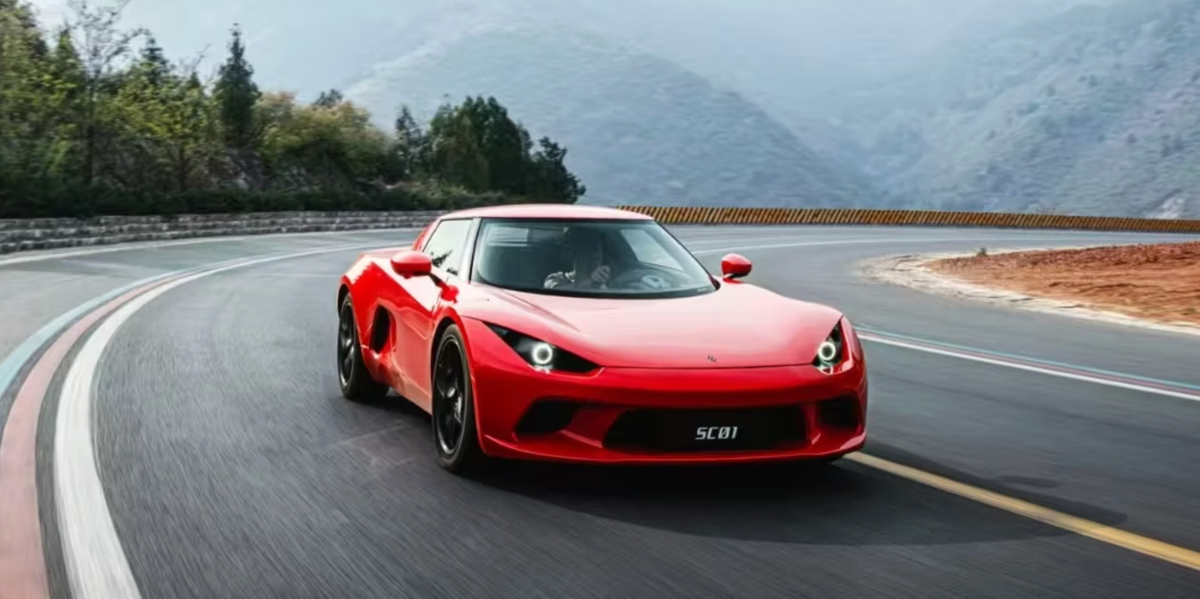
The Small Sports Car Company's SC01 packs 430 horsepower into a 3,000-pound EV with a sub-three-second 60-mph sprint — and it's priced like a four-cylinder Mustang.
Colin Chapman's Gospel, Electrified
Seventy-five years ago, Anthony Colin Bruce Chapman founded Lotus on a doctrine of subtraction. His 1960s Elan made the case convincingly: alongside a period MGB, the little four-cylinder Lotus makes the British roadster feel like a Ford F-150. "Simplify, and add lightness" was the creed, and for decades it separated Lotus from heavier, blunter rivals.
Those days are gone. Today's Lotus showroom includes the Eletre, a 5,500-pound Chinese-built electric crossover that sits uneasily with the founder's original mission. The gap between the Elan's philosophy and the Eletre's curb weight is where the Small Sports Car Company has chosen to operate.
Mazda famously read the Elan as a roadmap when developing the original Miata — not copying it, but bottling its spirit in a friendlier, more affordable package. That playbook worked spectacularly. The SC01 runs the same route, except the lightness is battery-powered this time, and the production line sits in China rather than Japan.
The Weight Is the News
The SC01 is SSCC's first effort, and its most impressive figure has nothing to do with power. At just over 3,000 pounds, it lands within a few hamburgers of a Toyota GR86 — remarkable for an EV, whose battery packs usually wreck any chance at lightness. The Elise comparison isn't flattering on paper; a proper Elise weighs far less. But against modern electric machinery, the SC01 is practically a featherweight.
The powertrain consists of two electric motors fed by a 60-kWh battery, producing just under 430 horsepower. That's 10 percent less than a Ford Mustang's 5.0-liter V-8, in a vehicle weighing a quarter less — a combination that explains the claimed sub-three-second sprint to 60 mph and a range of roughly 300 miles. It even launches in British racing green, a color chosen to signal which heritage it's chasing.
Suspension Choices With a Trade-Off
The SC01's silhouette suggests a mid-engined Lotus — something in the Evora family — but the engineering underneath is where the enthusiast intent shows. Unequal-length control arms at all four corners, paired with inboard springs and dampers, are the kind of details you'd expect on a track-focused machine, not a value-priced EV.
There's a practical cost to that layout. Inboard dampers sit tucked within the chassis rather than outboard at the wheels, which means a suspension refresh involves more disassembly and labor than on a conventional McPherson-strut car. The owner pays for the handling at service time. What the layout buys is reduced unsprung weight and a flatter, more controlled ride, contributing to a power-to-weight ratio adjacent to a Porsche 911's. That's the trade-off the SC01 makes: more workshop hours later, more cornering composure now.
The $34,000 Catch
In its home market, the SC01 sells for the equivalent of $34,000 — squarely in four-cylinder Mustang territory. That figure buys what looks like a well-sorted, Evora-adjacent sports car with near-911 performance. The mixed bag arrives when you try to get one elsewhere.
U.K. pricing has not been released, and the company is using Britain as a beachhead for Chinese automakers testing Western appetite. Any path to the United States runs through tariffs that would immediately inflate that $34,000 figure well past its appeal. Sports cars are also a narrow niche, and this is a brand with no dealer network, no service history, and no local reputation. Realistically, the SC01 will not turn up at your next track day. The car's existence, though, proves the formula can be built at a price point the West long abandoned.
A Path Stateside, Maybe a Familiar One
There's precedent for a lightweight sports car outliving its original maker's direction. Caterham still sells a car derived from one of Lotus's earliest designs — a formula that has survived decades precisely because it stayed true to the lightness principle. A similar arrangement could one day bring the SC01, or something like it, to American roads: a distribution partnership, a licensing deal, or a re-badge that separates the Chinese manufacturing from Western retail.
Lotus itself might take notice. If the Eletre represents the brand's commercial present, the SC01 demonstrates that the founder's original philosophy still has market appeal when executed properly. Whether it arrives via Caterham-style licensing, a Lotus adaptation, or another channel entirely, the SC01 settles a genuine question: the rise of the electric crossover does not mean the death of the small sports car. It just needs a lighter battery.