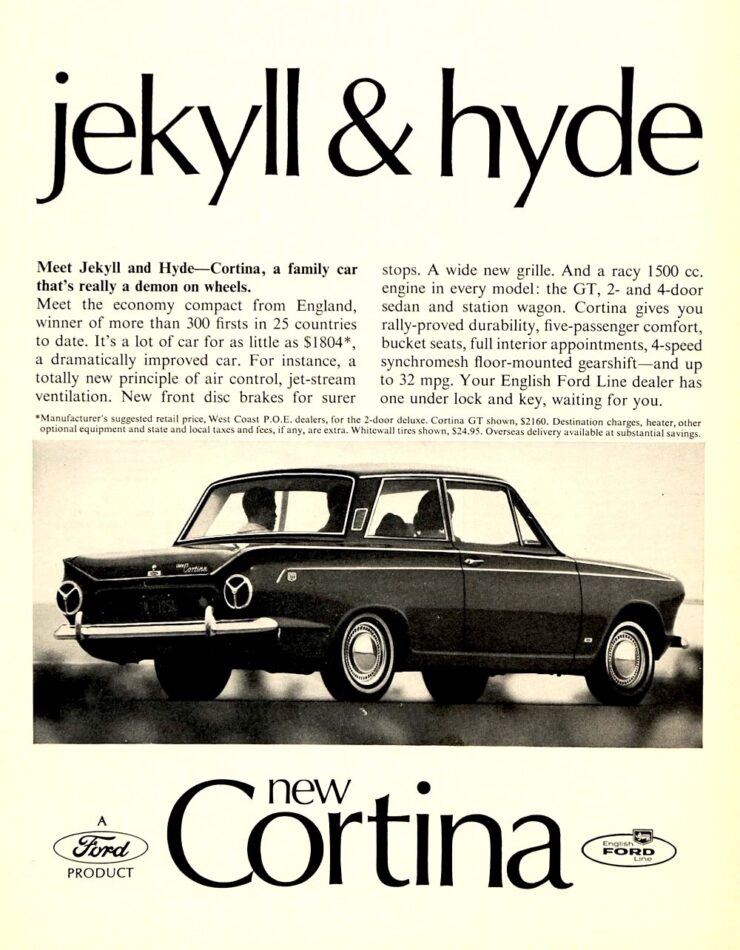
The 347 V8 Is Only the Start of This 1965 Ford Cortina GT’s Sleeper Transformation
A six-speed gearbox, independent suspension, four-wheel discs, competition-inspired bodywork and cabin, and a 2013 rebuild complete this understated Cortina’s transformation.
The 347 V8 changes the entire brief
The defining feature is Ford’s 347-cubic-inch V8, converted to fuel injection and estimated at roughly 400 bhp with more than 400 lb ft of torque. That output radically eclipses the original Cortina GT engine, turning a lightweight British saloon into a rear-wheel-drive performance car with far more power than its restrained appearance suggests. Air Flow Research Renegade aluminum heads support the engine, while an eight-stack injection system gives the installation its most obvious mechanical flourish. Holman-Moody valve covers, an MSD Pro-Billet distributor, an Aeromotive fuel-pressure regulator, and an electric water pump complete the hardware list. A low-profile oil sump was needed for the tight engine bay. Stainless-steel four-into-one headers send exhaust toward MagnaFlow mufflers, with the system exiting through the rocker panels rather than the factory rear position. The result is a compact car whose performance hardware is hidden in plain sight.
Six forward gears put the power on the road
The V8’s torque reaches the rear wheels through a Tremec six-speed manual transmission, giving this Cortina a drivetrain suited to both acceleration and sustained road use. The gearbox conversion required a modified transmission tunnel, one of the body changes made during the rebuild. That detail matters because it shows the project was not a simple engine swap: the shell was altered around a larger, stronger powertrain. The original Cortina specification used a four-speed all-synchro gearbox, so the Tremec adds two ratios while replacing an arrangement designed for a 78-bhp four-cylinder. Rear-wheel drive remains central to the car’s character, but the upgraded transmission gives the driver a much wider spread of ratios than the period setup. The combination also places greater demands on the chassis, brakes, cooling system, and rear structure. Here, those areas were rebuilt rather than left to cope with the V8 by chance.
Independent suspension replaces the factory compromise
The standard first-generation Cortina used MacPherson struts at the front and a live rear axle on leaf springs. This car discards that conservative layout in favor of independent suspension at both ends. Up front, a Mustang II-style assembly uses tubular control arms, electric-assisted rack-and-pinion steering, and adjustable MCS coilovers. At the rear, a Heidts independent subframe with tubular linkages provides the modernized architecture, while the brakes are mounted inboard. MCS dampers are fitted at all four corners, allowing the suspension to be adjusted rather than locked to one fixed road setting. The changes are significant for ownership because the car’s handling no longer follows the behavior of an unmodified 1965 Cortina. It has a contemporary custom chassis beneath a shell whose visual cues remain unmistakably period. That mix is the central engineering story: the body preserves the vintage footprint, while the suspension geometry and steering hardware belong to a much more ambitious build.
Four-wheel discs match the engine’s demands
Stopping power comes from Wilwood calipers and drilled, slotted rotors at both axles. A trunk-mounted brake booster with dual master cylinders operates the system, separating the braking hardware from the engine bay and accommodating the extensively revised chassis. The upgrade is essential in a car producing several times the power of the original GT. The period Cortina GT did receive front disc brakes and lowered suspension, but its rear arrangement and braking equipment were never designed around a fuel-injected V8 and six-speed manual transmission. The modern installation also works with the inboard rear-brake layout, which is part of the Heidts independent subframe conversion. Yokohama Advan A052 tires provide the contact patch, fitted to upgraded wheels beneath the otherwise restrained bodywork. For a prospective owner, the key point is that the braking package is integrated with the rest of the build rather than added as a cosmetic detail. The car’s stopping system is custom equipment, not restored factory specification.
The body hides a competition-style makeover
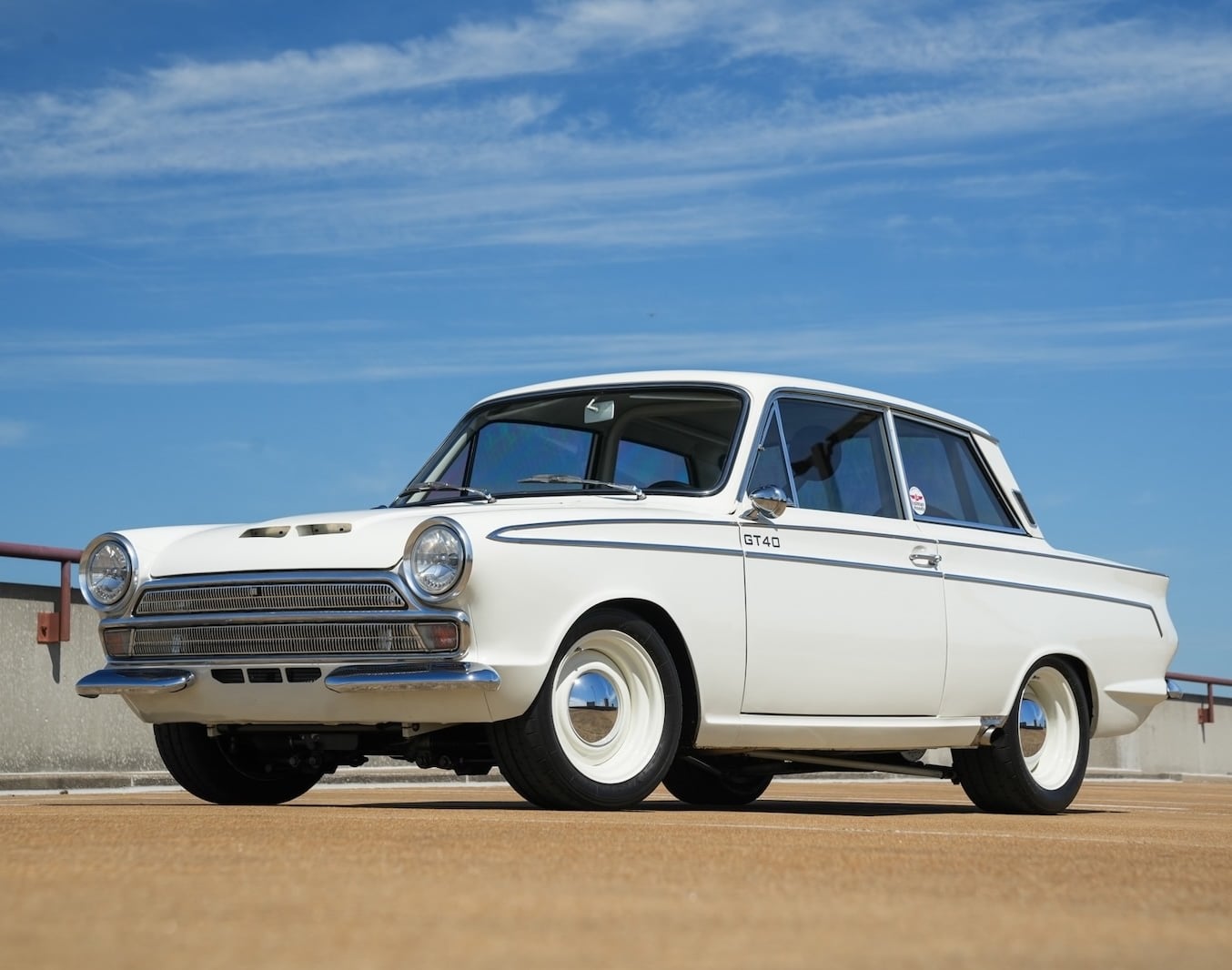
The exterior is deliberately quiet: plain white paint, color-keyed 15-inch steel wheels, and baby-moon hubcaps give the Cortina the appearance of an unusually tidy survivor. Underneath that restraint, the body was stripped to bare metal, repainted, and modified for the drivetrain and suspension work. The rear wheel wells were tubbed for additional clearance, and custom side panels were fabricated for the engine compartment. A bifurcated hood scoop is the main visual admission that something unusual lives beneath the bonnet. Other additions include a Le Mans-style fuel filler, bullet-style side mirrors, and tri-bar headlights with inset LED indicators. The exhaust outlets in the rocker panels are another clue, though they remain easy to overlook beside the steel wheels and simple paint. This is a genuine sleeper formula rather than a show-car disguise: the silhouette and color suppress attention while the scoop, side exits, and low stance reward closer inspection. Nothing about it advertises the engine’s estimated output.
The cabin is built around restraint and restraint systems
Inside, the Cortina trades period touring-car charm for a focused custom cockpit. Fixed-back bucket seats trimmed in black sit inside a six-point roll cage, with Willans harnesses replacing ordinary road-car restraint equipment. A MOMO Prototipo steering wheel is mounted on a tilt column, and Smiths instruments provide the visual link to the car’s British origins. The gauge set includes a 200-mph speedometer and a tachometer with a 6,500-rpm redline. Coco mats cover color-coordinated carpeting, while a push-button Motorola AM radio remains in its original location. Behind the seats are two spare tires and a cooler, an unusually practical touch in a cabin dominated by safety and performance hardware. The arrangement makes the car’s priorities clear: the interior supports fast driving, but it still retains recognizable Cortina details. The roll cage and fixed seats also mean this is not simply a comfortable vintage commuter with a larger engine; the cabin has been shaped around the car’s intended use.
Its 2013 rebuild explains the car’s finished state
Johnny Riddling of Atlanta, Georgia, rebuilt the car during a year-long project completed in 2013. That timeline puts the current specification in the category of a fully engineered custom rather than a recent collection of bolt-on changes. The car is left-hand drive, an important distinction for a model most closely associated with Britain and right-hand-drive production. Its visual restraint continues into the documentation: the digital odometer shows 1,200 miles, while the Florida title records 21,419 actual miles. Those two readings describe different points of the car’s history, with the lower figure belonging to the digital instrument rather than the title’s stated vehicle mileage. The car was offered from Springfield, Missouri, after the rebuild had established its present configuration. That combination of location, title notation, and build history gives the ownership record more substance than a generic “restored” description. It is a modified Cortina with a documented project background, not a factory-original GT.