A Dashboard Clock Request Became Two Louis Vuitton Porsches
Singer Vehicle Design and Louis Vuitton turned two 964-generation 911s into a saffron coupe and a white cabriolet — the maison's first co-branded finished product.
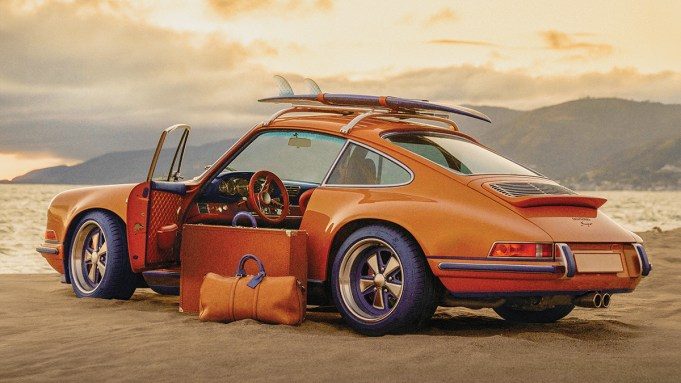
What exactly did Louis Vuitton and Singer build together?
The project spans two reimagined Porsche 911s: a hardtop coupe and a cabriolet, both based on the 964-generation 911 that Porsche produced from 1989 through 1994. Singer stripped donor cars to their chassis, restored and bolstered them, then fitted carbon-fiber bodies and added muscle. The coupe wears a saffron finish with cobalt-blue accents, a combination that has helped define Louis Vuitton's color palette, while the cabriolet is finished in white reminiscent of the limestone around Paris, with contrasting gold highlights. What began as a request for a single car expanded into two complete vehicles, according to Jean Arnault, Louis Vuitton's watch director. Both cars carry the fingerprints of both houses — Singer's restoration and engineering, Louis Vuitton's color and material language, each element commissioned specifically for the build. The result is a pair of drivers' cars that double as rolling exhibitions of LV's craft traditions.
How did the collaboration come about?
The collaboration began with a request for a dashboard clock, according to Jean Arnault, the head of Louis Vuitton's watch division, before evolving into a broader project to personalize every functional element of the vehicle. Arnault, who has a background in mechanical engineering, took an active role in defining the aesthetic for the coupe. "I have always been drawn to the precision, complexity, and craftsmanship behind exceptional mechanical creations," he says. He explains that Singer and Louis Vuitton share a passion for travel, adventure, and a true commitment to crafting objects: "We are both driven by the ambition to achieve the highest standard of craftmanship with uncompromising quality and meticulous attention to every detail." The partnership aligned naturally with both companies' values, Arnault says.
What interior details did Louis Vuitton contribute?
Inside the saffron coupe, the signature malletage motif — the diamond-quilted pattern from Louis Vuitton's trunks — dominates the seating, as Singer founder Rob Dickinson notes: "For the saffron-colored car, the malletage motif in the interior is a beautiful detail." Both cars are upholstered in leather referencing LV's VVT line and each contains removable Tambour timepieces. The coupe's cabin is accompanied by bespoke luggage: a tailored Bisten, a Keepall, and an exclusive bag sized for the matching helmet, while a roof rack carries custom skis and a handmade surfboard whose monogram appears in oak-and-walnut marquetry. In the cabriolet, the gearshift rises from an interpretation of the Noé handbag, drawstring intact, creating an analog oasis; a modular three-piece trunk is designed to fit precisely beneath the hood. Louis Vuitton patterns recur throughout both interiors, tying the cars to the maison's leather and watchmaking divisions.
Who designed each car, and what shaped their vision?
Jean Arnault, the watch chief at Louis Vuitton, defined the aesthetic for the coupe, drawing on his background in mechanical engineering. Nicolas Ghesquière, artistic director of Louis Vuitton's women's collections, focused on the cabriolet. "Automotive design is a passion that has always lived within me," Ghesquière says, adding that his contribution was "a chance to reconnect with this fascinating world." The cabriolet's styling takes cues from wooden speedboats—particularly the rear storage compartment, which could double as an art installation when open—and its detachable canopy resembles a taut sail. Arnault's engineering background led him to take an active role in defining the coupe's aesthetic. Ghesquière's vision for the cabriolet is evident in its sculptural, nautical details, such as the rear compartment and the canopy.
What luggage and accessories come with the cars?
The coupe's specially designed LV luggage includes tailored examples of the Bisten and the Keepall, plus an exclusive bag for the matching helmet. A roof rack carries custom-crafted skis and a handmade surfboard featuring LV's monogram iconography in oak-and-walnut marquetry. The cabriolet includes a modular three-piece trunk designed to fit perfectly beneath the hood. The Bisten is one of the maison's classic hard-sided trunks, while the Keepall is its iconic soft duffel — both tailored specifically for this project rather than drawn from the existing catalog. The surfboard and skis are one-off pieces built to travel with the car, and the roof rack extends the LV treatment to the full touring experience. Each piece carries custom detailing consistent with the car it accompanies.
What is the history of the Louis Vuitton Monogram?
Louis Vuitton's Monogram pattern turns 130 this year. Georges Vuitton, the founder's son, developed the repeating motif in 1896 to set the brand apart from imitators — the company's waterproof, lightweight, stackable canvas trunks had inspired a rash of knockoffs. The design pairs intertwined L's and V's with three floral symbols drawn from Gothic cathedrals and Japanese family insignias. Pierre-Louis Vuitton, head of savoir-faire and part of the family's sixth-generation leadership, notes that the original patent explicitly allowed the motif to be interpreted in different colors, sizes, and materials. Artists including Urs Fischer, Yayoi Kusama, and Takashi Murakami have reimagined it over the years — Murakami's Multicolore version sets the letters loose in a rainbow. For the Monogram's 130th birthday, Louis Vuitton created the Monogram Emblème, a woven organic cotton-linen blend with a subtle three-dimensional effect.
What's in the capsule collections that accompany each car?
Each reimagined 911 comes with its own Louis Vuitton capsule collection, with items varying by vehicle. The sartorial trappings include a leather racing jacket, straight-cut jeans, footwear, eyewear, a Tambour Automatic watch, and a suit made of parachute silk. The suit is the most unusual choice — parachute silk is better known for aerospace use than tailoring, but it fits the travel ethos both brands share. The Tambour Automatic watch extends the Tambour timepiece family found in the cars themselves, giving the owner a matching wrist instrument. The capsule collection is designed as a complete wardrobe for the motoring experience, covering everything from driving gear to formal wear, and its composition shifts depending on the vehicle in palette and pieces alike. The leather racing jacket and parachute-silk suit bracket the range — track-adjacent to formal.