Inside ECD's Heritage Defender: A Ground-Up TD5 Diesel Rebuild Starts At $159,995
The Heritage collection pairs a rebuilt 2.5-liter five-speed diesel with two body styles, fifteen factory colors, and selective cabin upgrades—all assembled in-house at ECD's Kissimmee, Florida facility.
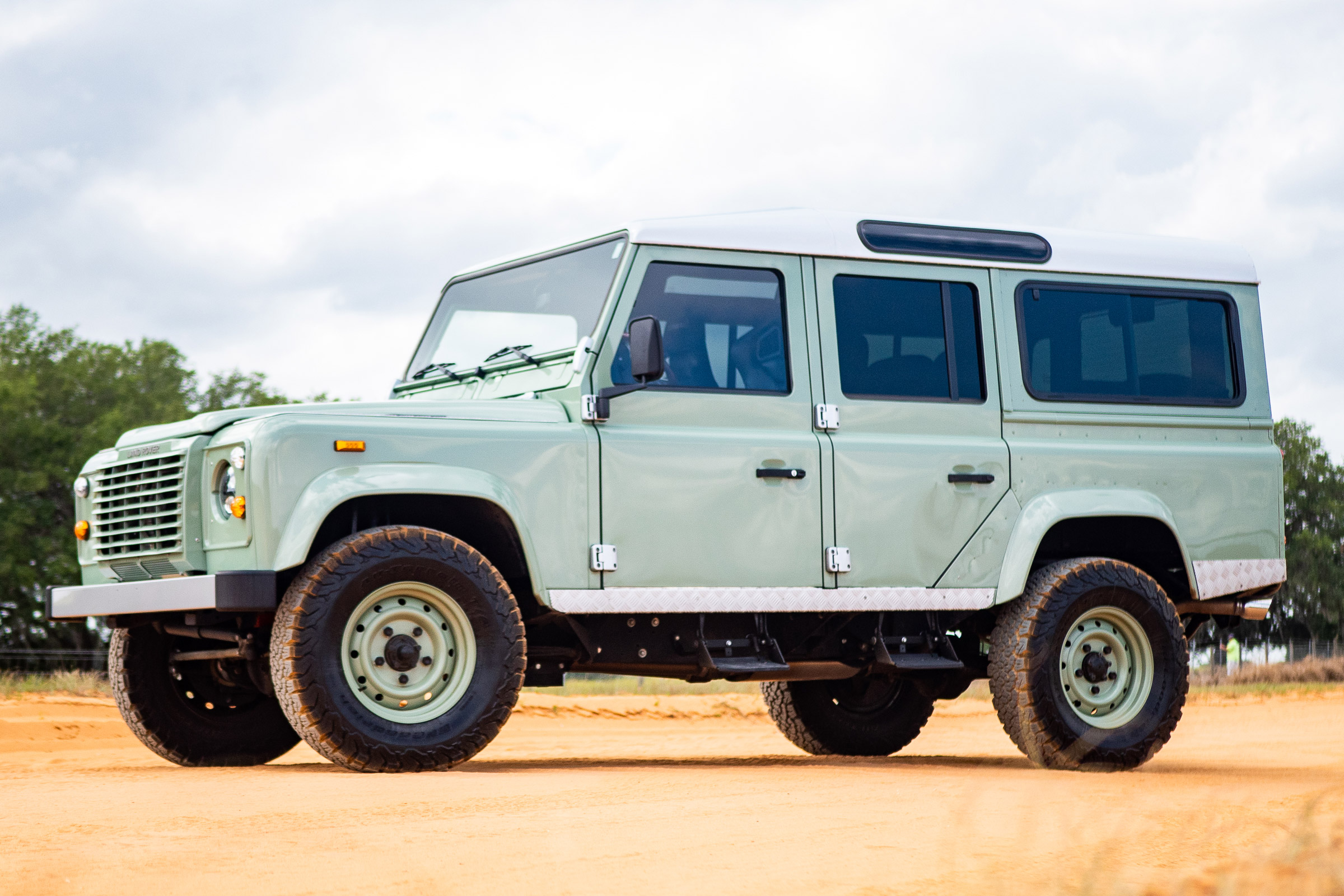
Every major drivetrain component gets a ground-up rebuild
Beyond the engine and gearbox, Heritage builds receive a rebuilt original transfer case, rebuilt factory axles, and full-time four-wheel drive through the stock layout. ECD installs stock-style suspension and OEM braking components rather than upgrading to aftermarket kits. The approach preserves the axle articulation, gear ratios, and pedal feel that defined the Defender's on-road character. The transfer case distributes torque through the same mechanical pathways as the original, while the rebuilt axles retain factory differentials and ring-and-pinion ratios. Stock-style suspension means coil springs and live axles rather than independent setups or air-ride conversions. OEM braking components maintain the original pedal travel and stopping distances rather than shortening them with larger rotors or multi-piston calipers. For a buyer cross-shopping a Singer-restored Porsche or an ICON Toyota, the philosophy is the same: replace every wear surface, keep every mechanical interface original. The result is a truck that drives like a low-mileage classic Defender, not a restomod pretending to be one.
Two body styles cover six or nine seats
The Heritage line offers a Defender 90 with a six-seat interior, and a Defender 110 that accommodates nine occupants. The Defender 90 uses a pair of forward-facing benches behind the front seats, while the longer Defender 110 adds a third row to reach its nine-seat capacity. Neither body style receives stretched wheelbases, wide-body flares, or chopped roofs—ECD keeps the factory dimensions intact. The trucks retain their original breakover angles, approach angles, and turning circles, which matter off-road far more than any aftermarket bumper or lift kit. The Defender 90's shorter footprint makes it more maneuverable on tight trails and in urban environments, while the Defender 110's additional length provides seating for larger groups and more cargo space behind the third row. Buyers choose between the two based on passenger capacity and intended use rather than any difference in specification or build quality. Both body styles receive the same TD5 drivetrain, suspension, braking, and reliability upgrades, ensuring consistent mechanical character regardless of which configuration suits the buyer's needs.
Fifteen factory colors and Wolf steel wheels anchor the exterior
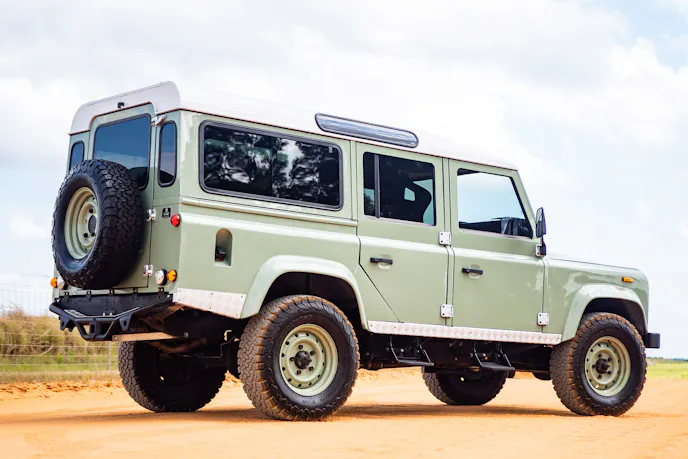
Buyers choose from 15 traditional Land Rover paint colors, applied over ECD's bodywork. The trucks ride on 16-inch Wolf steel wheels—the same pattern fitted to military-specification Defenders—shod in either Michelin Defender highway tires or Pirelli Scorpion all-terrains. The Michelin option prioritizes on-road comfort and tread life, while the Pirelli Scorpion provides deeper tread blocks and more aggressive sidewalls for unpaved surfaces. Slim bumpers, classic grilles, folding side steps, OEM-style hardware, and black checker-plate fender protectors complete the look. There are no LED light bars, no roof racks, no hood-mounted spare carriers. The visual restraint is the point: a Heritage Defender parked next to a current-production Land Rover looks like it belongs to the same bloodline, not a different species. The Wolf steel wheels reinforce the utilitarian aesthetic—these are stamped steel, not alloys, and they complement the slim bumpers and checker plates rather than competing with them. Buyers who prefer a different wheel aesthetic can option 18- or 20-inch designs, but the standard 16-inch Wolf steelies are the Heritage's visual signature.
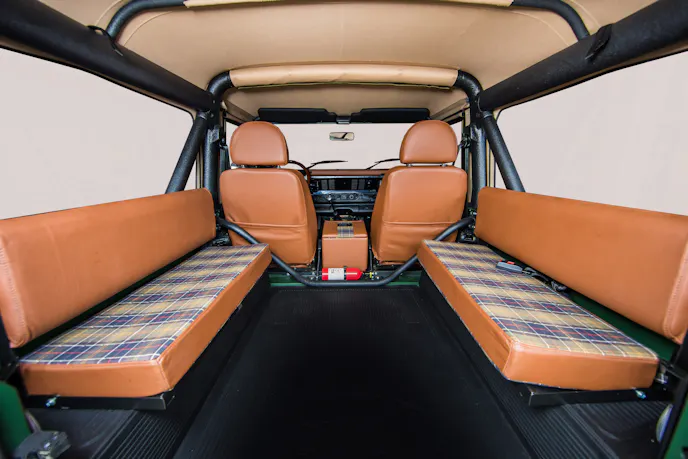
The cabin stays utility-first with selective modern additions
Standard Heritage interiors include black vinyl seating, the original TD5 dashboard layout, a Momo Prototipo steering wheel, lined floors, and heavy-duty rubber mats. The vinyl seats wipe clean after off-road use, the rubber mats contain mud and water, and the lined floors reduce road noise without adding carpet that would trap moisture. ECD then integrates under-dash air conditioning, Bluetooth audio, USB charging ports, LED interior lighting, remote central locking, and front power windows. These additions use discrete mounting points and factory-style switchgear to avoid cutting into the dashboard or door cards. The under-dash air conditioning unit supplements the heater without requiring dashboard modification, while Bluetooth audio replaces the need for a head-unit swap. The result is a cabin that retains the Defender's utilitarian layout while addressing the comfort shortcomings that limited the original trucks to fair-weather use. Buyers who want leather upholstery, Apple CarPlay displays, or rear entertainment screens can option them separately, but the standard specification keeps the interior honest—vinyl floors, rubber mats, and a steering wheel designed for work, not show.
Optional upgrades span suspension, protection, and appearance
ECD offers heavy-duty suspension kits, an ARB winch bumper, upgraded exhaust systems, alternative stitching patterns, modern audio packages, tubular side steps, roof-mounted lighting, and a four-point roll cage. The heavy-duty suspension raises ride height and increases spring rates for loads or rough terrain, while the ARB bumper provides recovery points and winch mounting. Wheel options extend to 18- and 20-inch designs beyond the standard 16-inch Wolf steelies, allowing buyers to shift the visual stance from utilitarian to contemporary. For exterior personalization, the company supplies Chelsea Truck Company wide-body components, Kahn exterior trim pieces, and an X-Lander grille and lighting package. These options range from functional recovery gear—winch bumpers, roll cages, side steps—to cosmetic flourishes like alternative grilles and wheel finishes. Leather upholstery replaces the standard vinyl, and modern audio systems with Apple CarPlay displays add smartphone integration. None of these upgrades alter the Heritage's core mechanical identity. The TD5 and manual gearbox remain standard unless the customer explicitly requests the EcoBoost swap, meaning the driving character stays intact regardless of how extensively the buyer personalizes the exterior or interior.
Pricing starts at $159,995, positioning it below ECD's flagship builds
The Heritage line opens at $159,995 for a base-specification Defender 90 or 110. That price point makes the Heritage the most accessible entry into an ECD Defender, reflecting its simpler specification: a rebuilt stock engine instead of a crate motor, vinyl instead of leather, steel wheels instead of alloys. The TD5 and manual gearbox are included in the base price, as are the reliability upgrades—aluminum cooling system, stainless exhaust, new fuel tank, and OEM fuel components. Standard equipment extends to the interior basics: black vinyl seats, Momo steering wheel, rubber mats, under-dash air conditioning, Bluetooth audio, USB ports, LED lighting, remote locking, and front power windows. Buyers who add leather upholstery, Apple CarPlay displays, entertainment screens, heavy-duty suspension, ARB bumpers, upgraded wheels, or Chelsea Truck Company body components will see the price climb, but the core mechanical package—the TD5, manual gearbox, rebuilt drivetrain, and reliability fixes—comes standard. For a buyer who wants a comprehensively rebuilt Defender without paying for a restomod that drives like a different vehicle, the Heritage occupies a distinct price point in the ECD catalog.
ECD's Kissimmee, Florida facility handles every build in-house
All Heritage Defenders are built at ECD's East Coast headquarters in Kissimmee, Florida. The company manages body-off restorations, paint, interior fabrication, powertrain assembly, and final testing under one roof. This in-house model means a Heritage buyer deals with a single vendor from specification through delivery, rather than coordinating between a chassis supplier, an engine builder, and an upholstery shop. The body-off process strips each donor Defender to its frame, allowing ECD to address rust, structural damage, and corrosion before any mechanical or cosmetic work begins. Paint and bodywork happen in the same facility as the engine rebuild and interior assembly, ensuring consistent quality control across every stage. ECD is not affiliated with Jaguar Land Rover Limited, though it uses the Defender and Range Rover trademarks under nominative fair use. The company operates as an independent restorer, purchasing donor vehicles and rebuilding them to Heritage specification rather than sourcing new chassis or components from the manufacturer. Build timelines and deposit structures are available through ECD's sales team.