Nissan’s Elgrand Bets on Quiet Power as Toyota Alphard Pressure Mounts
A new hybrid minivan brings a different noise-cancellation target while its maker tries to recover ground in Japan.
What makes the Elgrand’s noise cancellation different?
Nissan says the new Elgrand will be the first vehicle with an integrated active noise-cancellation system designed to address both road noise and sound from the minivan’s hybrid powertrain. That is a narrower and more ambitious target than the cabin systems already found in plenty of premium cars. Most of those systems concentrate on road noise; this setup is intended to deal with two sources whose sounds do not behave alike. The distinction matters in a vehicle built around passenger comfort, because unwanted tire, pavement, and powertrain noise can occupy the cabin at the same time. Nissan’s claim concerns the system’s integrated design, not merely the presence of speakers that can produce an opposing signal. It is a claim about intended coverage, so the meaningful measure will be how much cabin noise occupants hear in actual driving. The defining feature is the attempt to counter both noise categories in one factory system.
How does the active noise-cancellation system work?
The system begins with acceleration sensors positioned around the vehicle. Those sensors detect vibrations most closely associated with noise entering the cabin, then the control system uses that information to create opposing sounds. The counter-signal is sent through the minivan’s speakers, where it is intended to cancel the offending frequencies before they reach occupants’ ears. This is an active process rather than passive insulation: the system responds to measured vibration and produces a matching control sound. The arrangement also explains why the technology is tied to the whole vehicle instead of a single seat or speaker. Sensor placement supplies information from several points, while the audio hardware delivers the response inside the cabin. The system’s operating chain is specific even without turning it into passive soundproofing: acceleration sensors read vibration, the system generates opposing control sounds, and the speakers broadcast them.
Can it cancel both road noise and hybrid-system noise?
Yes, that is the intended capability, but road noise remains the more difficult target. Road sound is random, with its frequency and amplitude continually shifting as the vehicle encounters changing surfaces and conditions. Noise from the powertrain has a different frequency character, so it requires a different control method. The Elgrand’s system is designed to handle both types rather than applying one generic cancellation signal to every sound. That distinction is important for ownership expectations: a system can be built to address a noise source without eliminating every trace of it in every driving situation. The system is intended to address road and engine noise, but its real-world effectiveness can only be judged on the road. Actual road experience remains the deciding evidence. The practical takeaway is precise: the system targets two different acoustic problems, and the unpredictable road component is the tougher engineering challenge.
Why is Nissan redesigning the Elgrand so radically?
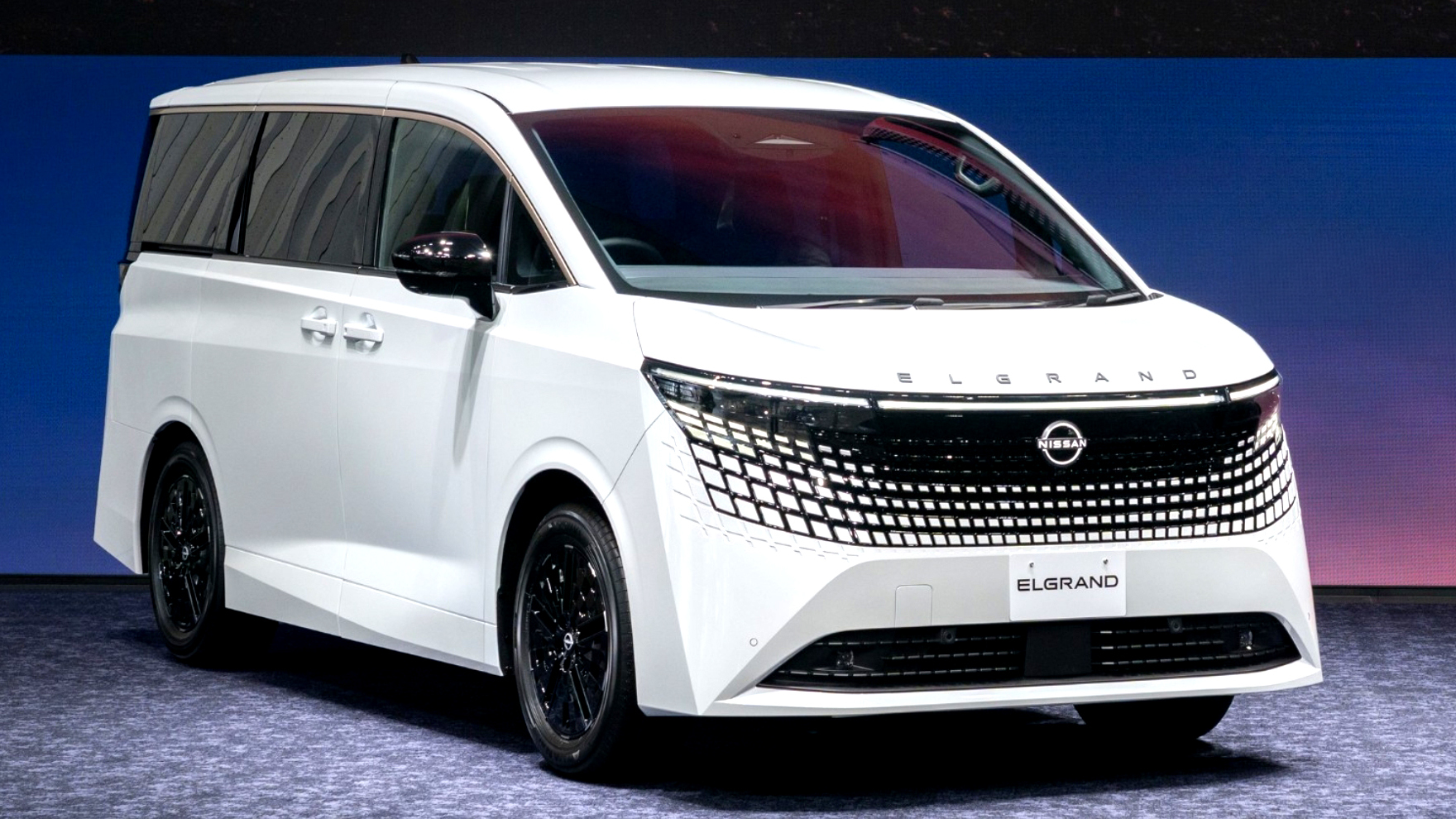
Nissan is trying to reclaim a position in Japan’s luxury MPV market, where the Elgrand has been overtaken by Toyota’s Alphard. The Elgrand helped create that popular segment, but its recent sales show how sharply the balance has changed. Toyota sold 81,357 Alphards during the 2025 fiscal year, while Nissan sold only 1,163 examples of the outgoing Elgrand in Japan during the same fiscal year. The new vehicle’s radical design is Nissan’s answer to that commercial gap. The strategy goes beyond adding a quiet-cabin feature: it combines a fresh visual identity, updated propulsion, and a comfort-oriented refinement claim in one replacement. Those sales figures describe the pressure behind the redesign, not a guarantee that the new model will reverse it. The immediate challenge is clear. Nissan is defending a nameplate that once defined luxury minivans against a Toyota model that now commands the category’s stronger sales position.
What hybrid powertrain does the new model use?
The new Elgrand uses the e-Power hybrid system, which the automaker describes as efficient. That powertrain is central to the vehicle’s identity because the noise-control system is designed to address sound from the hybrid system as well as sound generated by the road. The powertrain and acoustic refinement serve the same purpose: the minivan’s reason for existing is comfort, and the hybrid system is one of the noise sources being targeted. The new technology is also paired with a radical new design as the maker attempts to revive the model’s appeal. For ownership, e-Power identifies the propulsion format; fuel economy, battery capacity, acceleration, maintenance intervals, and hybrid-component replacement cost remain separate questions. Those details matter when comparing hybrid minivans. What is established is the hardware direction: an all-new Elgrand, an e-Power hybrid, and an integrated noise-control system intended to make the powertrain less intrusive in a cabin designed for comfort.
Will Nissan sell the new Elgrand in the United States?
No. Nissan will not sell the fourth-generation Elgrand in the United States. That makes its cabin technology relevant mainly as a technology to watch rather than as a specification available through Nissan’s American retail network. A US shopper cannot use the model’s standard dealer channel to compare its cabin, choose a trim, or arrange routine service for a locally sold version. The model’s absence also means there is no US-market price, equipment list, or warranty detail to use in a purchase calculation. Its importance is instead tied to Nissan’s home market, where the Elgrand helped establish the luxury MPV category and now faces a stronger rival. The announcement therefore has two separate implications: it introduces a new refinement feature on a vehicle Americans will not receive, and it shows how Nissan is trying to reposition a nameplate outside the US.
Could this noise-cancellation technology appear in other vehicles?
Yes, similar systems could appear in other production vehicles. Panasonic, the company behind the system, has supplied active noise-cancellation systems to more than 60 different vehicle models. That existing reach makes the Elgrand installation more than an isolated experiment, and its integration adds a new step in cabin refinement. The technology could therefore become relevant to future production vehicles if automakers decide that broader acoustic control justifies the added hardware and calibration work. Nissan’s development work makes adoption by other production models seem possible. That prospect matters beyond one minivan. Panasonic’s supply history is the clearest precedent, while the Elgrand provides a fresh application aimed at a hybrid minivan’s specific cabin challenge. For buyers, the meaningful development is not a promised rollout but a shift in what factory ANC can be asked to control: the road outside and the powertrain beneath the quiet cabin.